Stories
Family Stories
Each family can memorialize themselves here. Submissions are approved by the site administrator. Content is initially drawn from the bulletins.
Family Stories
Link to Album 1 – “Toilers and Revolutionaries”, the Zipim workers fifty years on (76 pages)
Link to Album 2 – family photograph album (38 pages)
An alphabetical list of families will appear here once content is processed from the bulletins.
Trips to Mezritch — People Tell Their Stories
Trip to Poland – Mezřich – August 2025
Landing in Warsaw 17.8.25 Trip to Krakow Visiting relatives and getting organized.
Monday 18.8.25 Departure towards Mezřich 10.00 am We arrived in Międzyzrze (Mezřich) Podalski at 16.00 After a long trip (6 hours) one way – back, I arrived in the town center.
The direction for the trip to Mezřich I used the website and a road map and with the help of Gila Shahar Finkelstein, who directed me and sent the details, that’s how I easily got to the place, thank you very much, dear Gila!
First meeting, in the central square with the obelisk statue in memory of the town’s victims.
A quick scan and search reveals and I stand in front of the sculpture “Prayer” created by sculptor Yael Artzi, a memory of our loved ones that the distinguished members of the Mezrich Immigrants Association Committee took care to present in Israel.
Honor - in memory of the Jews of Mezrich who were killed and murdered during the brutal Nazi German occupation.
The sculpture “Prayer” is located at the edge of the square, surrounded by a garden of plants and trees, including a seating area. Stone benches to be used for resting and sitting in front of the statue monument, which is also decorated with inscriptions in Hebrew and Polish to explain its meaning and what it represents.
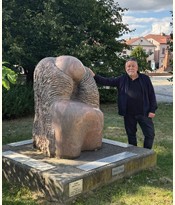
The tour of the city brings me to think about why I came, finding the home of my father Hersh (Zvi) Twardzewo, and my grandfather Haim Wolvo (Zeev) and my grandmother Chaycha (Hya) Twardzewo, their memory always blessed - Amen.
To see where and how they lived in the town of Mazyrz, what the feelings were and what it looked like, the place they told me about as a child, a little about what will not remain of my father’s house.
The need to trace the journey of the interesting and fascinating life story of my father Hersh Zvi Tverdzhevo - begins here.
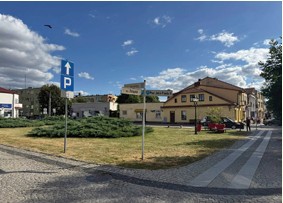
My father was a sculptor who became famous for his works and his great and wonderful talent, both in Poland and in the provinces of Russia, and through him a fascinating and amazing story unfolds, which I am building in a long puzzle, hoping that he succeeded…
His sculptural talent is what saved him several times in his life, from certain death in the labor camps where he served a death sentence (Kamchatka camp in Siberia) which was commuted to life imprisonment and a surprising release (more will be said about that)…
I found the house, a few minutes’ walk from the main square on “Staromuejska” Street 26 (Staromuejska), still the same appearance and shape as I received in the photo taken in 2011.
The house looks old and poorly maintained, in the parlance of the plantation, probably as is customary for the locals who live there. The front and back yards, the entrance to the building and the stairwell look as if time has stood still.
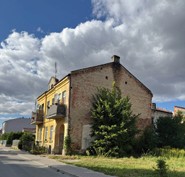
The unique yellow hue of the house reminded me of the color of that period (yellow gloom) for some reason brought the feeling of that time.
Opposite the house stands an old wooden house in shades of yellow-brown and looks from the same period of time … (the 50s).
The street is characterized by the appearance of the other surrounding houses as in the town, quite old houses between half-painted houses, some of which have also been upgraded and slightly renovated in character and design, if you can call that the local style.
In conversation with the people living in the area and tenants, I did not find a common language, they are busy with their daily lives and far from what I am looking for…
People came out of one of the doors of the building and ran past us in the stairwell as if we were not there.
I did not enter the apartments because I did not have the exact and respectful to bother.
I remembered the story my father used to tell that when he was released from the Soviet prison (Kalma - in Kamchatka) and arrived in the town he had to see what had become of his beloved parents, brother and sister, he discovered that the Nazis had massacred them except for the sister who managed to escape and escape the killing.
When my father entered the synagogue, he said Kaddish for his beloved parents and swore a “Bender” that he was leaving the land of Poland and making aliyah to the Land of Israel.
Despite the entreaties of his friends and colleagues in the field of art, he was promised excellent conditions with a living wage and the status of an honored artist with a studio in the National Museum, he refused and made aliyah to the Land of Israel.
So I went to look for the synagogue, and I did not find it - residential buildings had been built in the place where it used to be and everything was different.
I returned to the central square with the “Prayer” statue, sat down in the cafe across the square and thought to myself, this is the victory of my dear relatives who were killed here. I also feel proud for my father when I step on this place and prove that the damned hawks who wanted to destroy us did not defeat us and we cannot be destroyed as the Jewish people and as stubborn Israelis!
We, the successors of the generation, must come and visit with our feet the place and the home of our ancestors - and in their memory.
Haim Alon - Tverdzhevo.
Goldman Family Visit to Mezritch – November 2.11.25 / Yaakov Goldman, second generation of Mezritch descendants
As every year, the Goldman family travels for an annual vacation abroad. This year we decided to travel to Poland and combine a vacation with a roots trip to Mezritch.
The Goldman family numbers 15 people: parents (myself, Yaakov Goldman, and my wife Dorit), three children with their spouses, and 7 grandchildren.
My father’s entire Goldman family, and my mother’s Lamfert family, were born, lived, and mostly were murdered in Mezritch.
We planned the visit to Mezritch for Saturday, August 16th. It fell on a long Polish weekend - Friday the 15th was a Polish holiday (the Assumption of Mary and Polish Army Day), followed by Saturday and Sunday off.
Visit to the Cemetery
After driving from Warsaw, we arrived in 4 cars at the cemetery area. The area was full of Poles who had come to visit the Christian cemetery located across from the Jewish cemetery. The whole area was packed with cars parked everywhere possible. With great effort we found parking for our cars.
The Christian cemetery looked well-tended, clean and orderly. The Poles arrived in holiday clothes with bouquets of flowers in hand. The entrance to the Jewish cemetery is truly hidden. It took us about a quarter of an hour to find the entrance among all the parked cars.
Next to the gate stands a small house belonging to the cemetery. Before the war it served as a house for purifying the dead and preparing them for burial. After the war the house served the cemetery’s visitors - an elderly woman lived there who maintained the house, gave every visitor a book in which to record impressions from the visit, a second book listing the dead and their dates of death, and sold memorial candles. Today the house has been sold, a Pole lives there, there is no trace of the two books, and the gentile uses parts of the cemetery grounds for his own private purposes.
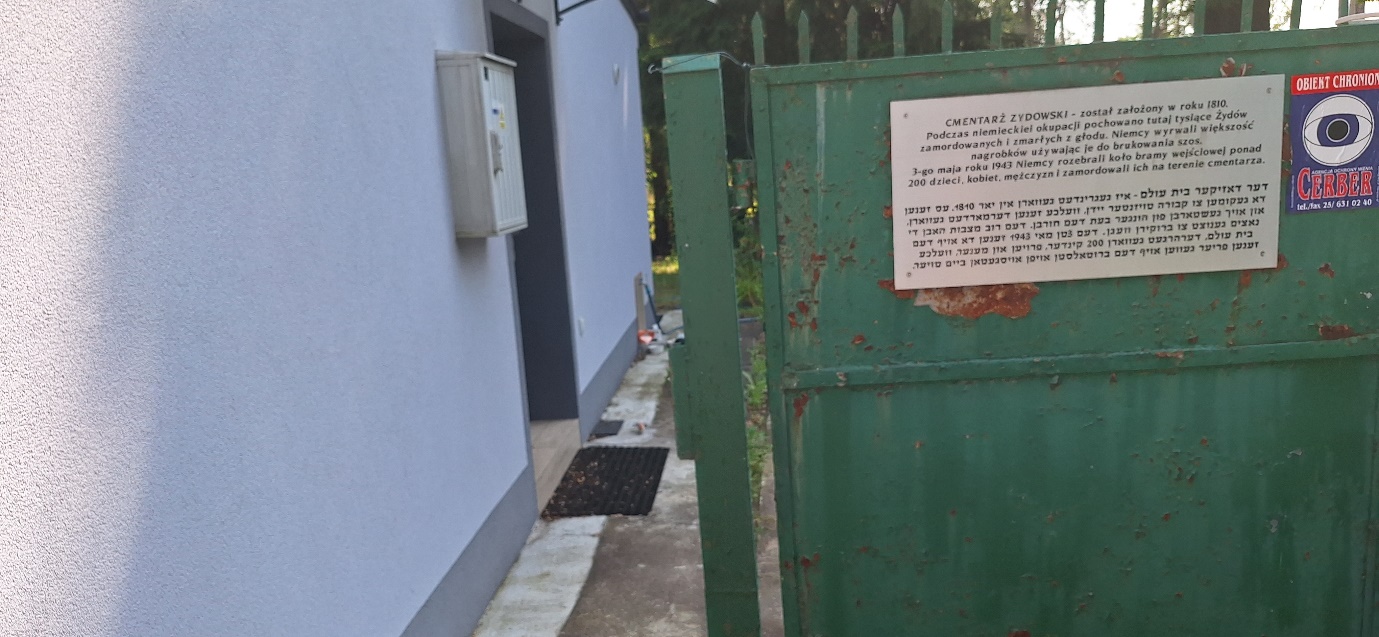
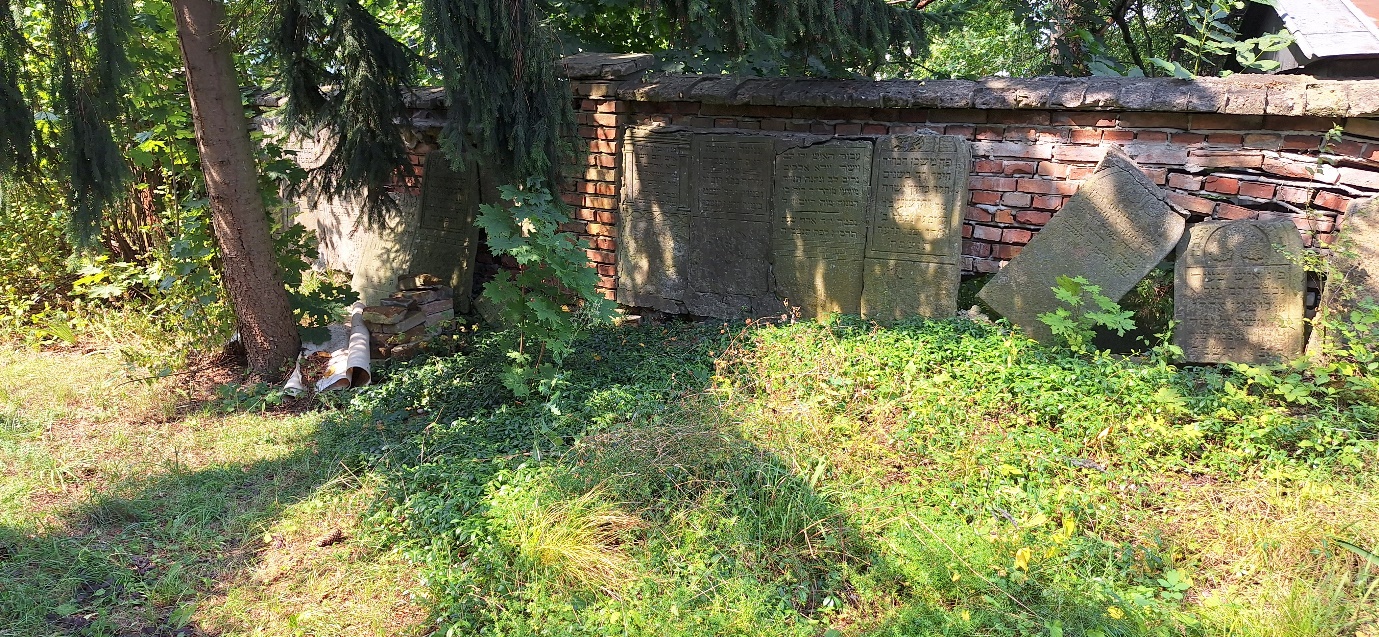
We entered the cemetery through the small opening. The initial sight was very depressing. The area is wild, no graves or headstones are visible, most of the ground is covered in tall grass, bushes and trees, everything growing wild. We stood stunned by the sight and the neglect. The only remnants visible are the headstones leaning against the cemetery’s wall.
Opposite the entrance stands the memorial stone for Sarah and Avraham Finkelstein, which their descendants took care to erect after the war. It too sits within a tangle of vegetation.
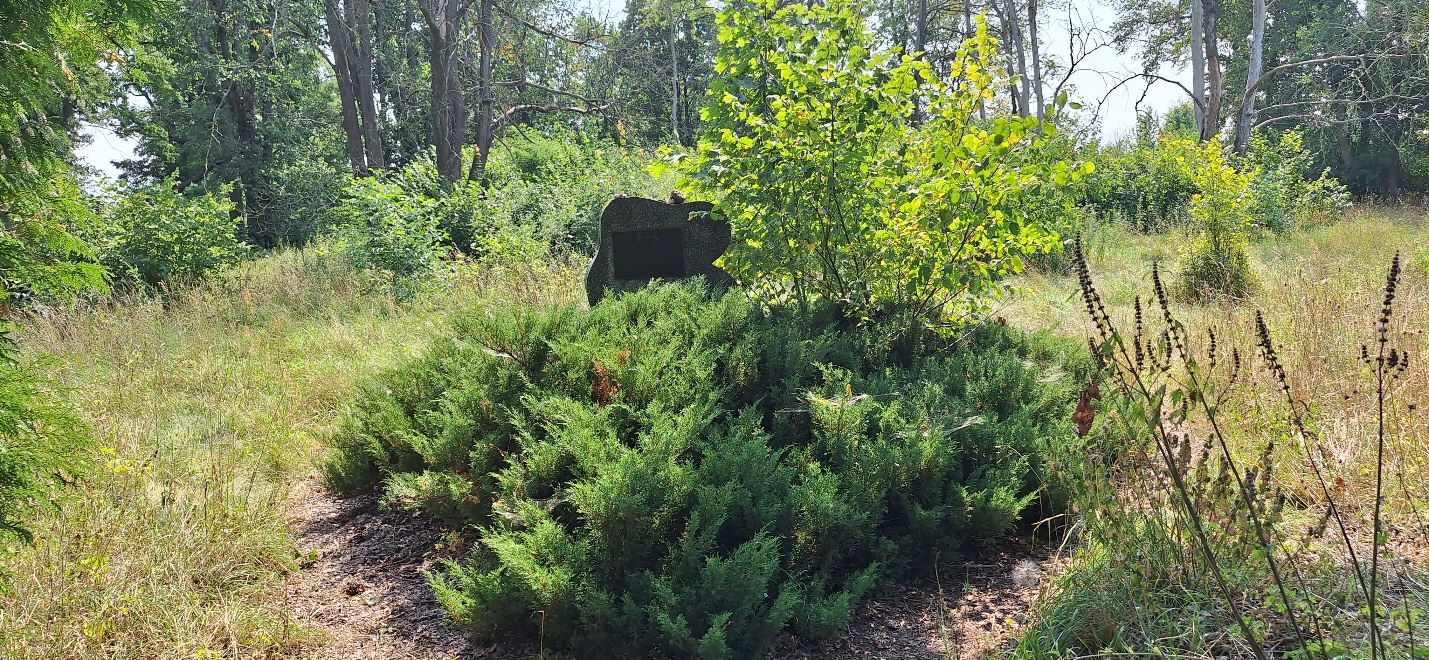
Further on, about 100 meters in, on the right side close to the fence, the headstone of a mass grave peeks out - in memory of about 200 Jews shot by the Nazis on 18.7.1943 at the cemetery entrance.
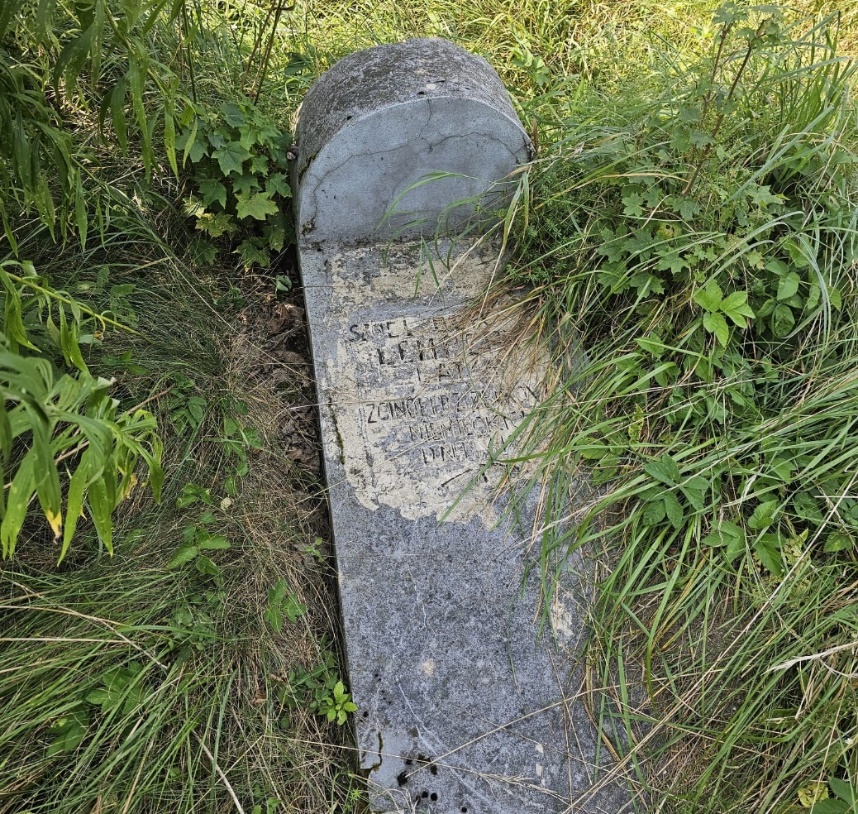
Since I had visited the cemetery several years earlier, I roughly knew where my family’s graves were located. We approached the southeastern side of the cemetery and, with our hands and feet, pushed back the vegetation and searched for the graves. The children and grandchildren spread out in a line and searched. The grandchildren were wearing shorts; the mosquitoes and insects showed no mercy and attacked them, drawing Jewish blood.
It took time until we found the first headstone. It was the grave of my maternal grandfather, Shaul Ber Lamfert. Shaul Dov (Ber) was a prosperous meat merchant. On 18.4.1942 the Ukrainians came to his house and ordered everyone outside. Grandfather Ber fled to a workshop and put on work clothes, but the Polish police arrived and ordered him out. He fled again. They chased him and killed him in one of the alleys.
Next to him, in the same row, we found the grave of his son Menes Lamfert, my mother’s brother. Menes was murdered on 5.10.1942 in Mezritch. The Germans shot him as he tried to flee and his clothes got tangled in a fence.
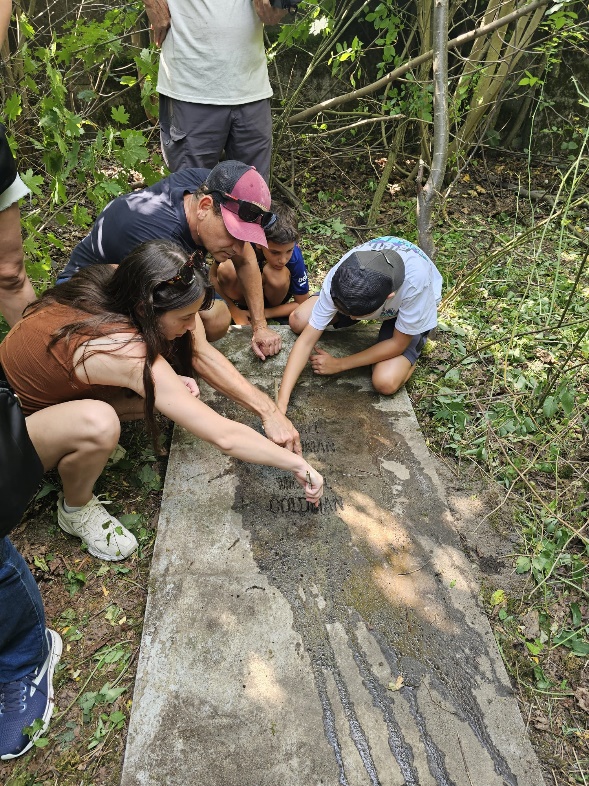
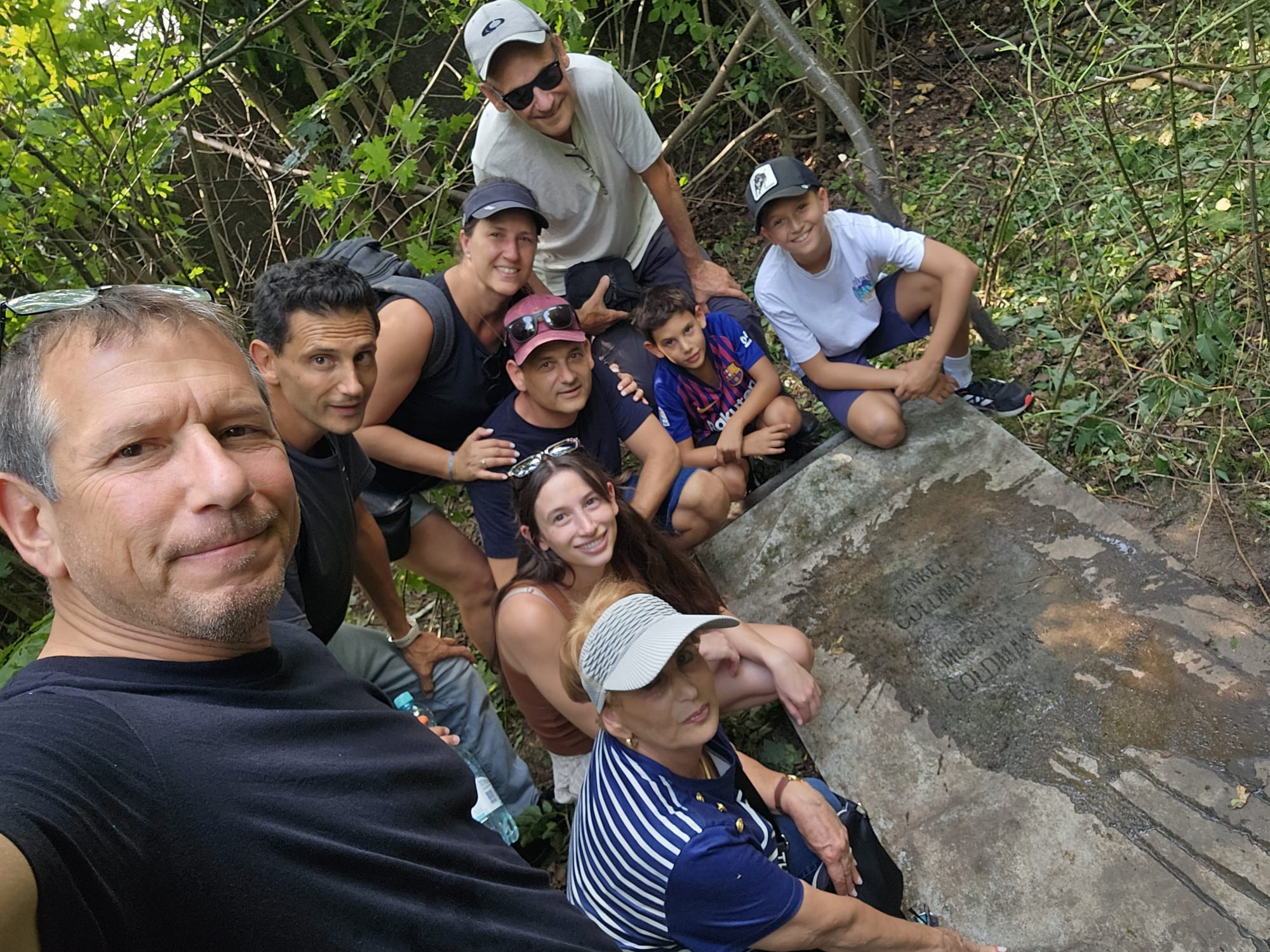
We kept searching in the thicket. After a while we moved to the area closer to the eastern fence of the cemetery, where the bushes were already shoulder-height and very hard to push through. Suddenly one of the grandchildren shouted “I found it” - and indeed he had discovered a headstone. The grave is shared by my grandfather Yankel (Yaakov) Goldman and his son Michael Goldman.
I stood, moved, in front of the grave of the grandfather I am named after.
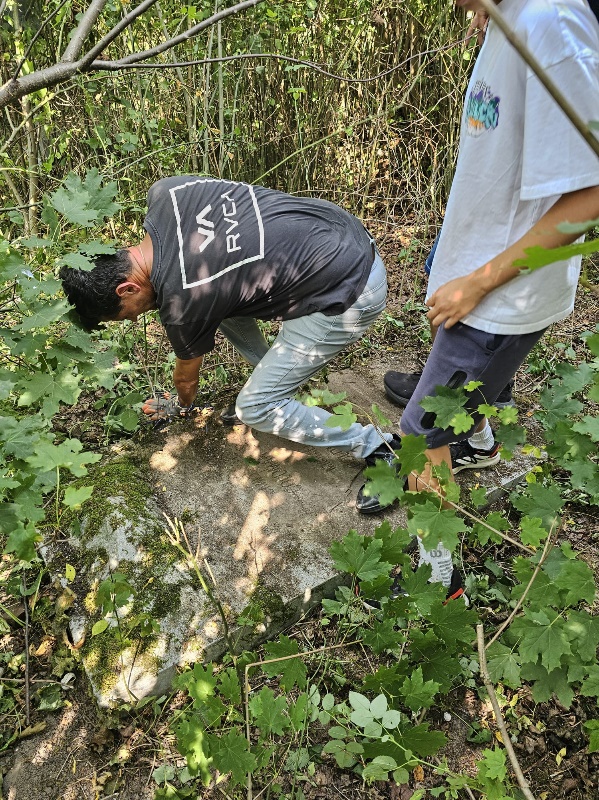
The children and grandchildren worked for about half an hour, by hand and with the little water we had, cleaning the grave and its surroundings. Once the grave was clean everyone stood together, and I told them how my grandfather was murdered and why the grave is shared with his son Michael. Everything was documented in photos and video that will remain as a family memory.
My grandfather Yankel Goldman was an industrialist, owner of a leather-processing factory. He was a traditional Zionist. He managed to survive the first three “Aktionen.” In the fourth Aktion, on 8.11.1942, my grandfather Yaakov, my father Hershel, his brother Leibel, and Michael and Sarah hid in the sawmill where the men worked. The Germans, together with Polish police, arrived at the sawmill. Leibel managed to escape. My father Hershel grabbed Sarah and the two of them fled the scene with the dogs chasing after them. My grandfather Yaakov stood his ground and did not move - he tried to delay the Germans and allow his children to escape. Michael tried to pull him away, and in the end both were shot and killed on the spot.
We remained standing for a while longer, stunned and moved, before the grave.
Further on, not far from my grandfather’s grave, we also found the grave of his daughter Leah, my father’s sister. Leah died a hero’s death after severe torture, refusing to give up the name of the friend who was forging documents.
The feeling from the sight of the Jewish cemetery, which looked like an abandoned, untended field with a crumbling fence, left us with a heavy feeling.
Visit to the Town Square
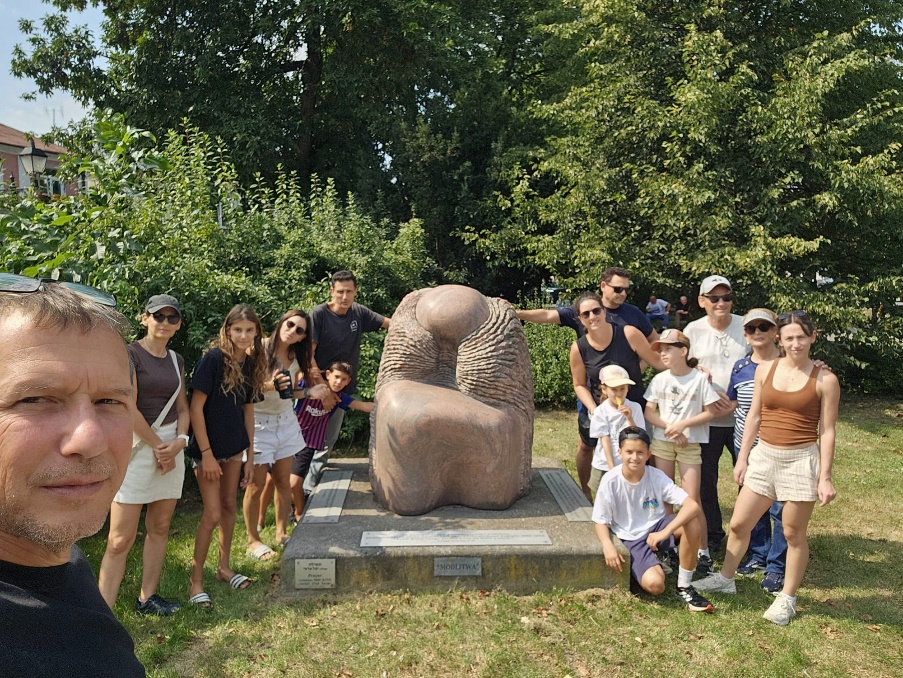
From the cemetery we drove to the town center, to the town square. First we went to see the “Prayer” sculpture. The sculpture commemorates the Jews of Mezritch and the surrounding area who were murdered by the German occupier in the Holocaust between 1939-1944. The inscription includes the verse from the Book of Genesis: “The voice of your brother’s blood cries out to me from the ground.”
And this is what I said to my children and grandchildren: our success and our revenge against the Germans who wanted to destroy all the Jews - it’s you. I just think about my father and mother, who came out of the war with no clothes, with nothing, when all their families had been murdered, and who managed to build a family and a clan. And slowly, that clan keeps growing and flourishing and succeeding in every sense.
From the sculpture we walked to another part of the square, to the house at Rynek 10, where my parents lived right after the war. The children photographed me standing in front of the house.
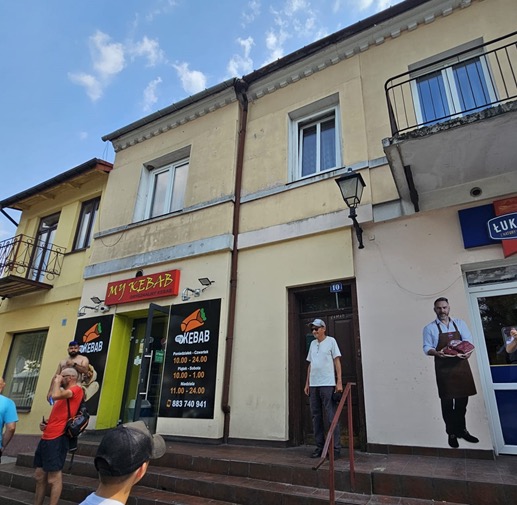
We then went to another side of the square and photographed the sign that was only recently added, in 2023. The sign was placed on one of the buildings and reads, in Polish and Hebrew:
In memory of the Jews of Międzyrzec Podlaski, citizens of Poland murdered by the Germans, marking 80 years since Operation Reinhard (1942-1943). Remembrance is our duty - Governor of Lublin Province.
After the visit to the town square we drove to eat at a pizzeria about 10 km from Mezritch. While we were eating, my son-in-law asked to say a few words, and this is what he said:
“This is what a picture of victory looks like. We are here now with an extended clan, after a moving visit to the cemetery, showing them what Jews are - the harder they hit us, the more we grow and flourish. You, Yaakov, should be proud, truly proud, for going to show the grave and scrape away the vegetation and the dirt, and to see here the glory of a creation that shows the Poles and the Germans what Jews are - ‘a people like a lion.’”
With that, we effectively concluded the moving visit to Mezritch.
Yaakov Goldman.
Yishai Wexler’s visit with his mother Sarah Wexler to Poland, July 14 to 19, 2004
Leaving Israel
Motzkin train station, Tuesday the 13th of July, 17:25, farewell and a kiss from our beloved Mali and Dad.
Between Tel Aviv and Petah Tikva we’re on the upper deck of the car, the only ones besides a young mother and her two small children (of course Mom manages to strike up a conversation in the five minutes of the ride and sing “Our Brother the Driver” with them), they get off in Bnei Brak.
In “Segula” big Zvi (husband of Bracha of the Lampert family) with his ever-present warmth hosts us in his car and we arrive at the Margalit family’s home, where wonderful Bracha showers us with kisses, joyfully and with her natural warmth, and of course, food.
We eat scrambled eggs, Aunt Tzina (wife of Hershel Goldman, who together with his sister Sarah, Bracha and her sister Tzina survived in a pit at the gentile Traszok’s) is also there sitting with us and joining the conversation, we look at various photos, among them the Traszok family, whom Mom and I are preparing to meet when we arrive.
A snatched night’s sleep, and at 05:30 Zvi drives us to the airport despite Mom’s protests that he shouldn’t trouble himself and get up so early - we’ll just order a taxi - as if we don’t know Zvi, a good and great soul, so why Mom’s needless Polishness?
Passport control at Ben Gurion Airport raises suspicion toward Mom - the burden of proof falls on Mom regarding the innocence of her identity, verifying the passport by means of her driving license.
And at the security check they find a hidden compartment in her wallet that even Mom didn’t know about, in which she habitually keeps one of a woman’s important tools, a nail file. We part from it forever and receive in exchange the right to enter the duty-free zone.
1,400 km, together with Mom - just the two of us, a first in my life, we spent hours upon hours talking, touring, reliving and surfacing memories of every kind, in fascinating stories and in brief moments of soul-baring.
Warsaw and the road to Mezřich
We arrived at Warsaw airport on the morning of Wednesday the 14th of July, equipped with a cell phone from home thanks to Moran, a rental car from Budget which Mom had booked in advance (a grey Opel Astra) was handed to us without delay while Mom already heads to the “kantor” (money changer) and exchanges about 250 greenbacks for about 800 zloty.
The weather is grey, temperature around 17 degrees.
We drove east to Mom’s hometown, “Międzyrzec Podlaski,” or as it’s called “Mezřich” by the Jews (Podlaski - the name of the region, meaning “forest-covered”), while our rental car crosses the center of the Polish capital I adopt for myself the basic rules of driving in Poland that I learned a year earlier on a visit with Dad, chiefly:
-
Not crossing the white line - in practice implemented only as a recommendation, even though the law states an absolute prohibition.
-
Driving most of the time with the shoulder line crossing the center of the car.
-
Turning left on a green light - right of way to the oncoming car, entering and waiting in the middle of the intersection.
The distance is about 120 km, after the first 80 km we pass “Siedlce” and find a picturesque, well-kept, new roadside hotel.
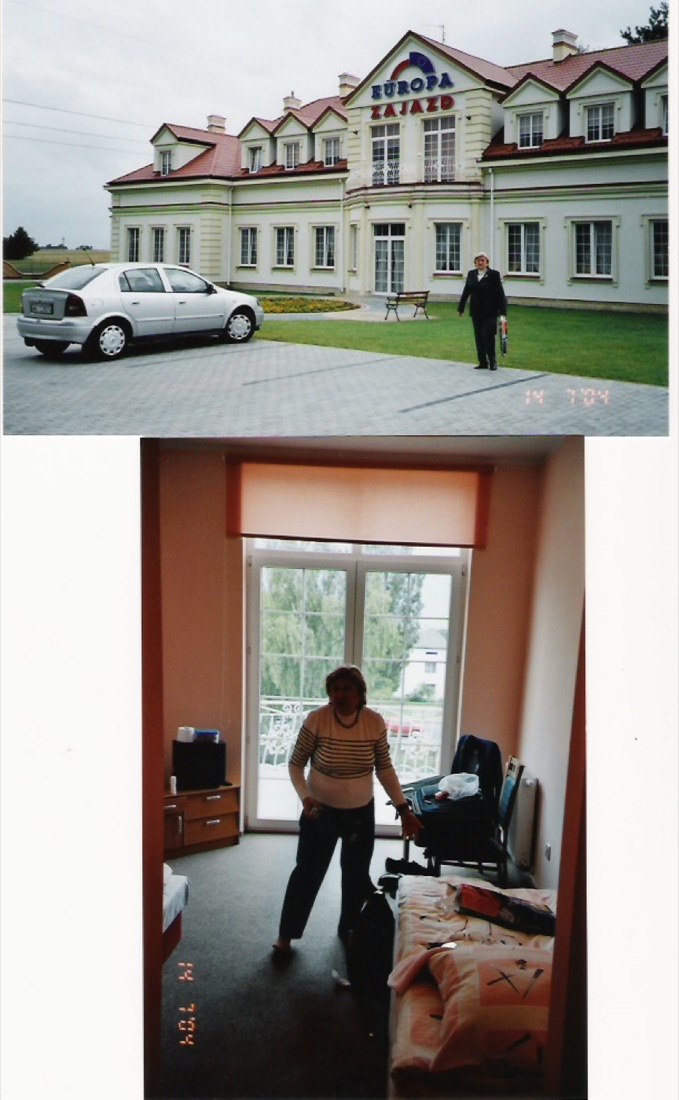
A young blond English-speaking receptionist shows us the room which, for 110 zloty (about $25), will serve us for rest and an overnight stay including breakfast, we place our suitcases, take photos and move on (by the time we reach Henryk Traszok this will already be a done deal and a reason we won’t accept his offer to stay and sleep at his house - privacy equals comfort).
Another 10 km or so, parking at a roadside inn, we try to get a calling card for pay phones, not available here. We drink coffee and blueberry cake at a ridiculous price, Mom swallows her pills and we move on.
First visit to the cemetery
An attempt to phone Henryk Traszok doesn’t go well, so we go straight to the cemetery in Mezřich, 14:20.
In the neglected, grey-dark parking lot a new green Daewoo is parked next to us. The old woman watches us through the glass window of her hut, opens the cemetery gate, Mom’s tongue is set free and the Polish in her mouth comes rolling out.
Tall green weeds make it very hard to move among the graves, the three murdered graves of the Lampert family and that of Leah Goldman, Mom’s sister who was murdered, are very easy to identify since they were restored not long ago (the work of Henryk Traszok’s hands).
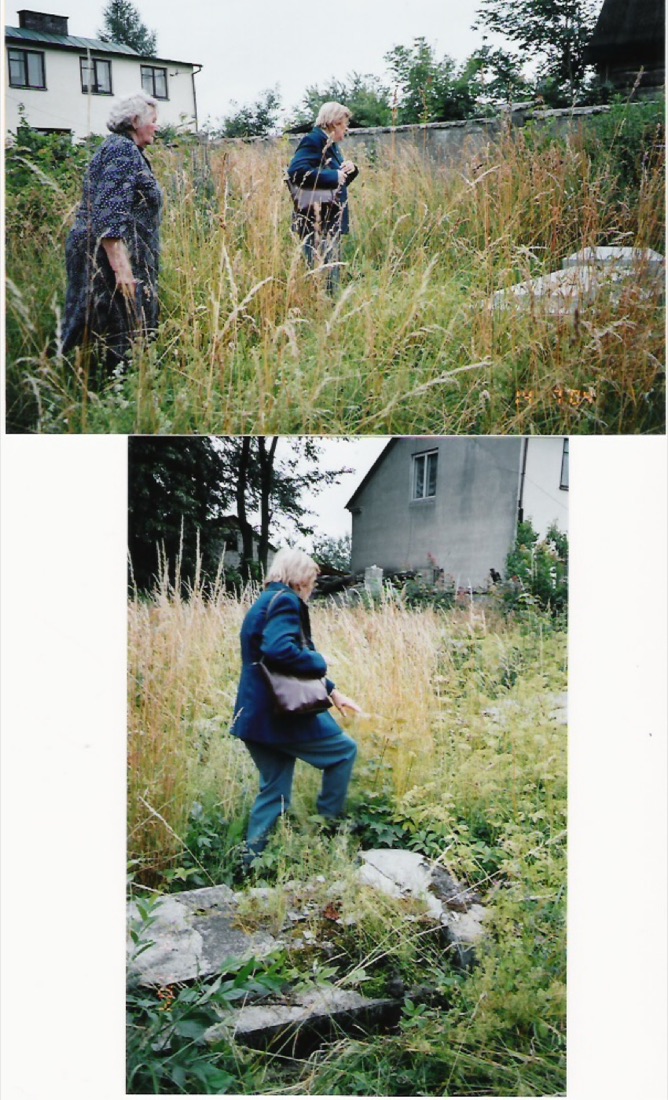
It’s evident that Mom is very moved, to put it mildly, moving in every direction through the thicket of greenery and the nettles that sting her hands while muttering to herself that she must meet with the mayor to demand he attend to the cemetery, suddenly she stumbles, lucky that the undergrowth is so dense that the fall is cushioned and causes her no harm at all.
We can’t find the shared grave of Yankel and Michael (Mom’s father and brother, murdered at the sawmill), identifying the spot in order to restore the grave is the purpose of our coming here.
Henryk Traszok enters the cemetery yard (I estimate he was in the area because the Daewoo in the parking lot is his, as it turned out later). Mom approaches him, kissing and chatting (the first thing Mom is asked about is whether she brought with her the certificate recognizing his right to be counted among the “Righteous Among the Nations”? Mom’s answer is evasive but in principle negative, the matter is being handled by Zvi Margalit, or as he’s known here, Henryk, who works tirelessly on it). I come and shake his hand, it seems I sense a coolness passing through his handshake to me, perhaps. A man in his early 60s whose appearance somehow recalls my uncle Hershel, mainly because of the hair and hairstyle.
Now the three of us move among the graves searching for any identifying sign that would reveal to Mom where our loved one’s grave is, the old woman who lives at the cemetery watches us from the path with a blank look.
A few more minutes of searching and we reach the conclusion there’s no chance, Mom decides to affix the aluminum memorial plaque she’s carrying in her bag to the lower part of Leah’s grave instead of on her father’s and brother’s grave, which she didn’t find.
And so Henryk and I bring the adhesive materials that Dad packed with the memorial plaque in Mom’s suitcase, Henryk does the work (glue) with unusual care for precise, perfect work, to myself I interpret this at that moment as if he’s trying to convince us how much he cares and how invested he is.
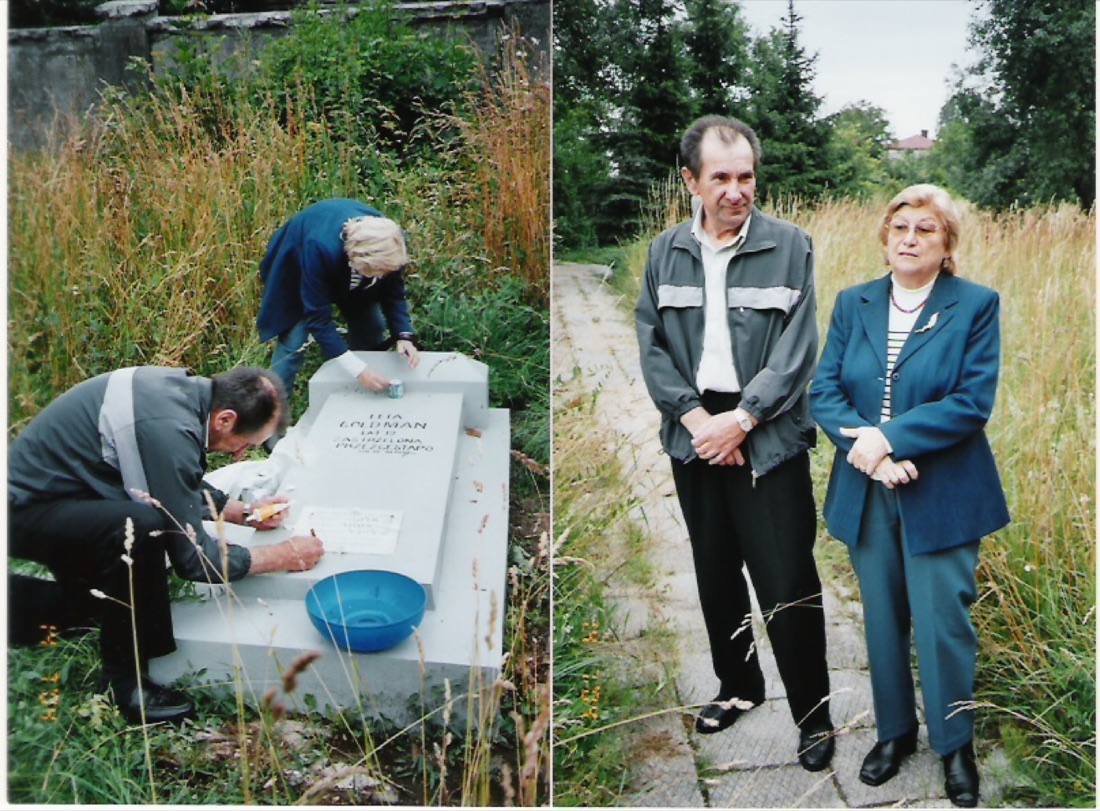
Mom finishes by lighting memorial candles on each of the four graves.
The old woman brings out the guest book, in which I recognize what Dad and I wrote when we visited here on August 31, 2003, it seems we were the last visitors here until today.
Mom writes a few sad words in the book which, even if I don’t quote exactly, their gist is “I was disappointed by the inability to complete the purpose for which I came all this way.”
An episode - while searching in the thicket of weeds I found an earring, which Mom had lost without noticing, I put it in my pocket without a word. A few hours later, when Mom discovered she’d lost an earring, which caused her a bit of grief, I pulled it from my pocket and gave her a small joy.
At the Traszok home
100 zloty to the old woman and we drive following Henryk’s car to his home in the heart of Mezřich.
The house is a detached house surrounded by a very well-kept garden of colorful flowers, we’re received warmly by his wife and daughter (I don’t manage to catch their names, so I don’t remember them), the wife is very attractive, light eyes and hair, a bit heavy. The daughter, by contrast, is thin and, to my taste, also pretty, his granddaughter Ola, age 9, from Lublin, is also here, of course light-haired and light-eyed and a bit chubby, for Mom of course this is another opportunity to make conversation, I take advantage of it to enrich my Polish vocabulary - tylko=only, matka=mother, sklep=grocery store, teraz=now, proszę=please, dziękuję=thank you.
And when Mom asks to wash her hands she’s led respectfully to a shiny bathroom without a sink, so hand-washing is done in the bathtub, following Mom, Mrs. Traszok hands each of us clean towels.
The inside of the house is unusually clean and shiny, everything in its place, I can’t manage to identify any possibility for a single speck of dust ever to penetrate this house. Every room is closed with a wooden door with a glass panel in its center, movement between rooms is done while opening and closing doors.
After a few polite exchanges, the gifts Mom brought are presented, envelopes from Matzevi, Bracha and Tzina, tablecloths, and I pull out of my wallet, at Mom’s request, $150 and hand it over. It seems to me these things are received as a matter of course.
We then move to the living room where a table is set with the finest delicacies, everyone is seated, tea glasses placed in front of each plate with a spoon on them.
Aside from half a hard-boiled egg with mayonnaise, a cup of tea and a bit of pastry, we didn’t taste anything, it’s well known that meat dishes abroad don’t agree with us.
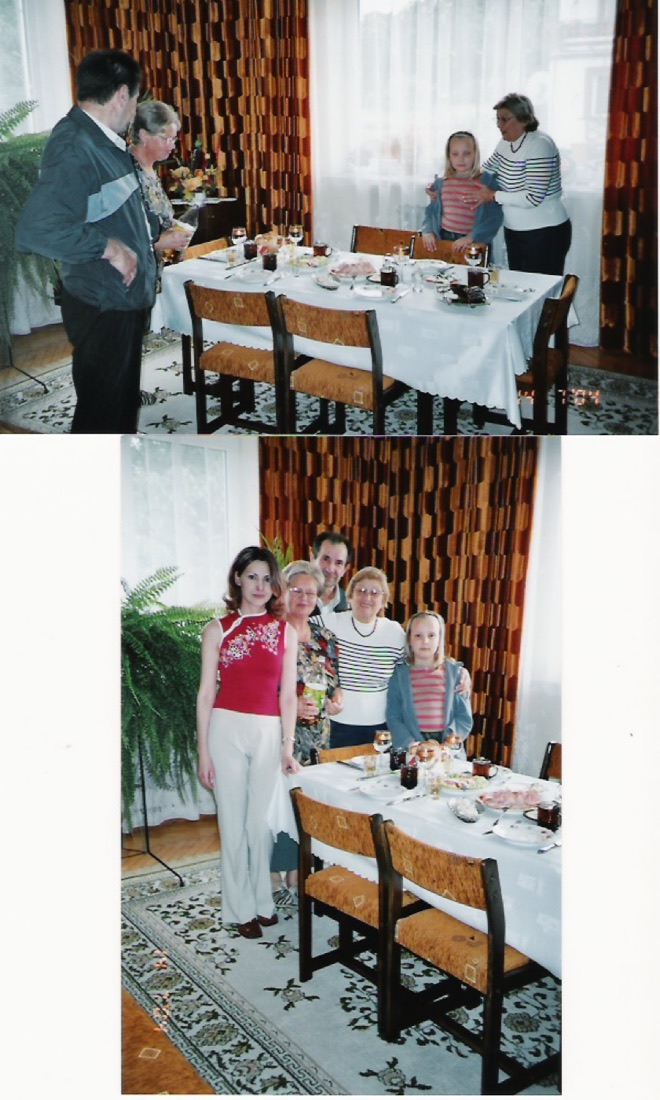
During the meal I felt several times a mutual awkwardness when my glances and those of Henyek’s daughter (a single woman a bit past 30) met.
The elder Mrs. Traszok urges me to drink another cup of tea (herbata), and when I agree the daughter rushes to pour, the tea is made by steeping the essence in the cup and drinking it after it settles.
Toward the end of the meal Henyek asks to bring in his sister Janina and her husband, so he steps out and returns about 20 minutes later, beside him stands a woman who clearly suffers a great deal, her movement slow and made with the utmost care because of leather braces fitted to her leg and left arm, the result of several strokes she suffered about 4 months earlier, every movement of hers is guided by her husband, a very thin man, alert and quick. After words of greeting they join the table and hungrily savor the various sausages and fish being served.
Janina has a beautiful daughter (according to the wedding photo shown to us) and a son, Izik, about 37, single.
As we sit at the table Mom took out the photo of the lost grave that she took about ten years ago, from a certain shape I identified in the photo I knew that tomorrow I could point with certainty to the grave and I promised Mom it would be so.
We said goodbye to the Traszok family and drove in the dusk about 30 km back to the hotel.
Second day in Mezřich – July 15th
On the morning of the 15th of July we ate breakfast at the hotel, the meal was prepared by a young woman with a lovely face and an unceasing smile (it later turned out she was the only charming waitress/receptionist/service provider we’d meet in Poland), of course it was necessary to emphasize that she shouldn’t put slices of “szynka” (ham) into the egg - it was tasty, aesthetic, and especially pleasant.
We arrive at Mezřich at 09:00, park the car on Lubelska Street (if my memory doesn’t betray me) more or less across from the square, we make our way through the alleys of the neighborhood where Mom lived, small old houses, some run-down and some well-kept, in the place where Mom’s house once stood there’s now a big store painted yellow, with many people around it - a fruit and vegetable market.
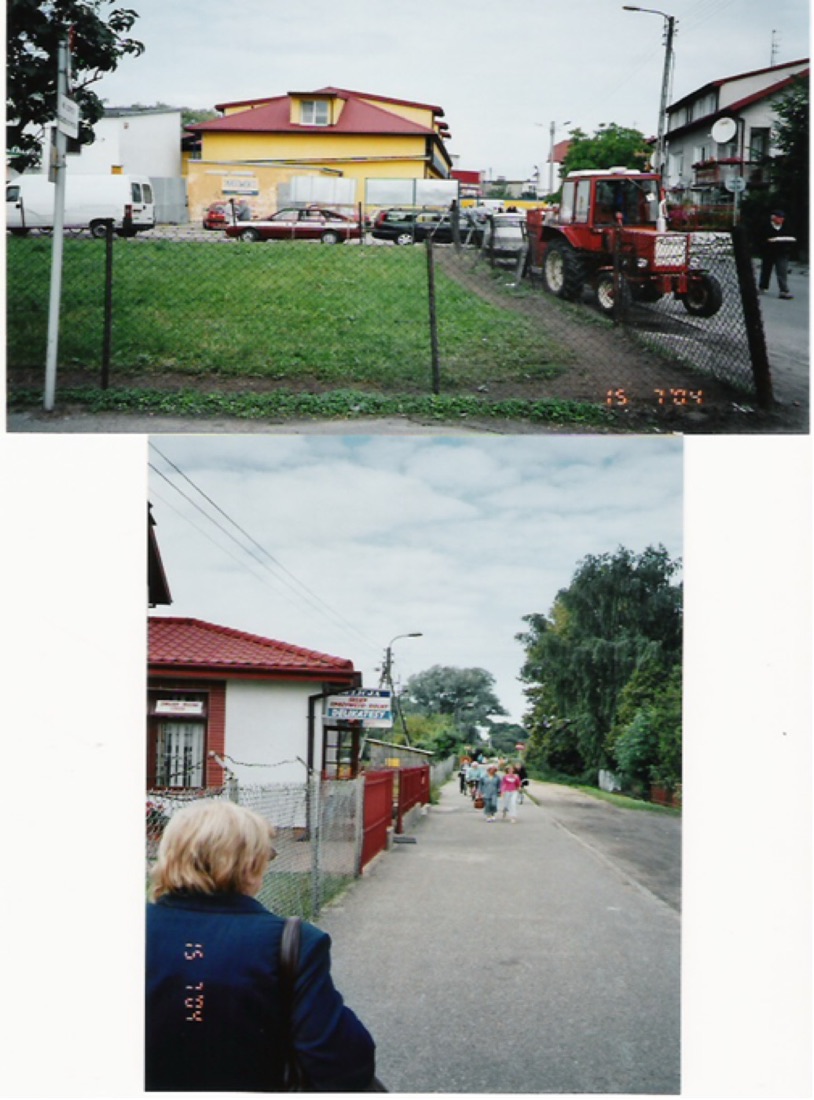
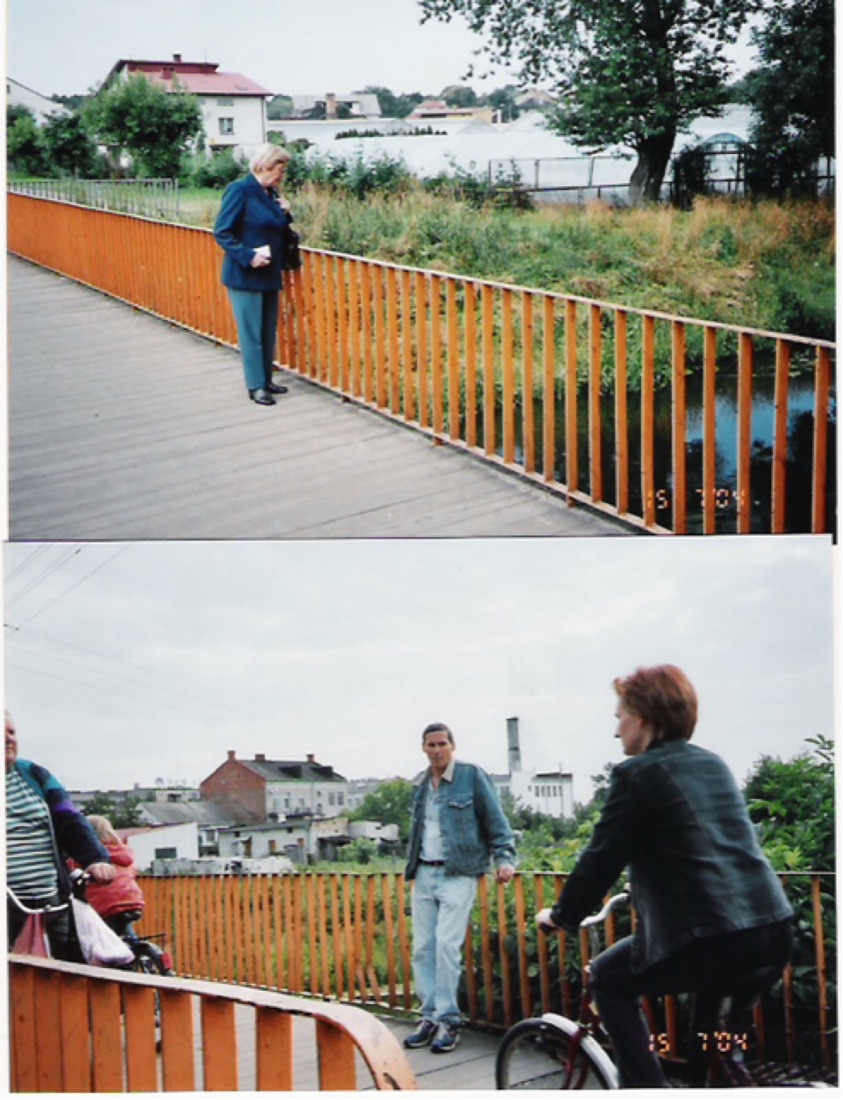
We continue toward the bridge over the stream, a bridge covered with wooden planks, a green expanse with walking paths separates the bridge from the road, people walk along the paths.
I photograph Mom on the bridge and a woman passing by mutters in Polish “photograph, photograph the filth” (Mom’s translation).
On this bridge, as a child, she once walked with her eyes closed as part of a game with her friends and fell into the water, a kind-hearted neighbor pulled her out of the water and carried her in her arms to my grandmother.
As we walk through the narrow streets Mom tells many stories about a house with a large gate that once stood here, and a leather-processing factory that Hershel had set up there, and another Jew who was jealous of his success and tried to frame him, causing him to sit in jail for a day or more but ultimately failed, and that’s where the terrible train station was, we find ourselves walking in another part of the town where the synagogue once stood, of which there is no trace at all, searching for a kiosk selling phone cards (insert a card - insert card) we reach a small supermarket and buy a few groceries there, no disposable cups, one register, a long line, everyone standing quietly.
While walking I notice a shop selling shutters and building materials, and on one of the shelves, disposable cups, we bought a pack of 200 for 11 zloty.
Around 10:00 we arrived again at the cemetery, this time the green “Daewoo” wasn’t parked in the area and the old woman wasn’t watching from her window.
We entered the cemetery and I led Mom to the grave, all the signs on the grave pointed to it being identical to the photo (the direction and shape of the cracks, the letter L, and the word “un” - in Yiddish meaning “with”) as Mom begins to be convinced this is indeed the grave, Henyek and his wife enter the cemetery grounds carrying work tools with them (about 50 meters of new extension cable, a vibrating drill of 1,000 watts, a spade, and more), a few more minutes of doubt as to whether this is indeed the grave, the problem facing Mom was the Roman numeral 11 identified with certainty on the grave, meaning the month, in the year ‘42, which according to what Mom knew was the 9th month. A few minutes pass and this matter too is resolved, since Leah was murdered in the 9th month and this is clearly visible on her grave, and the murder of my grandfather and uncle took place months later, so the contradiction doesn’t exist.
With great diligence Henyek’s wife begins pulling up the many weeds around the grave while Henyek scrapes with the spade the layer of moss and grass covering parts of the grave’s surface. The woman’s work is done with utmost devotion, and I, feeling uncomfortable, and with Mom’s wish added, join the work.
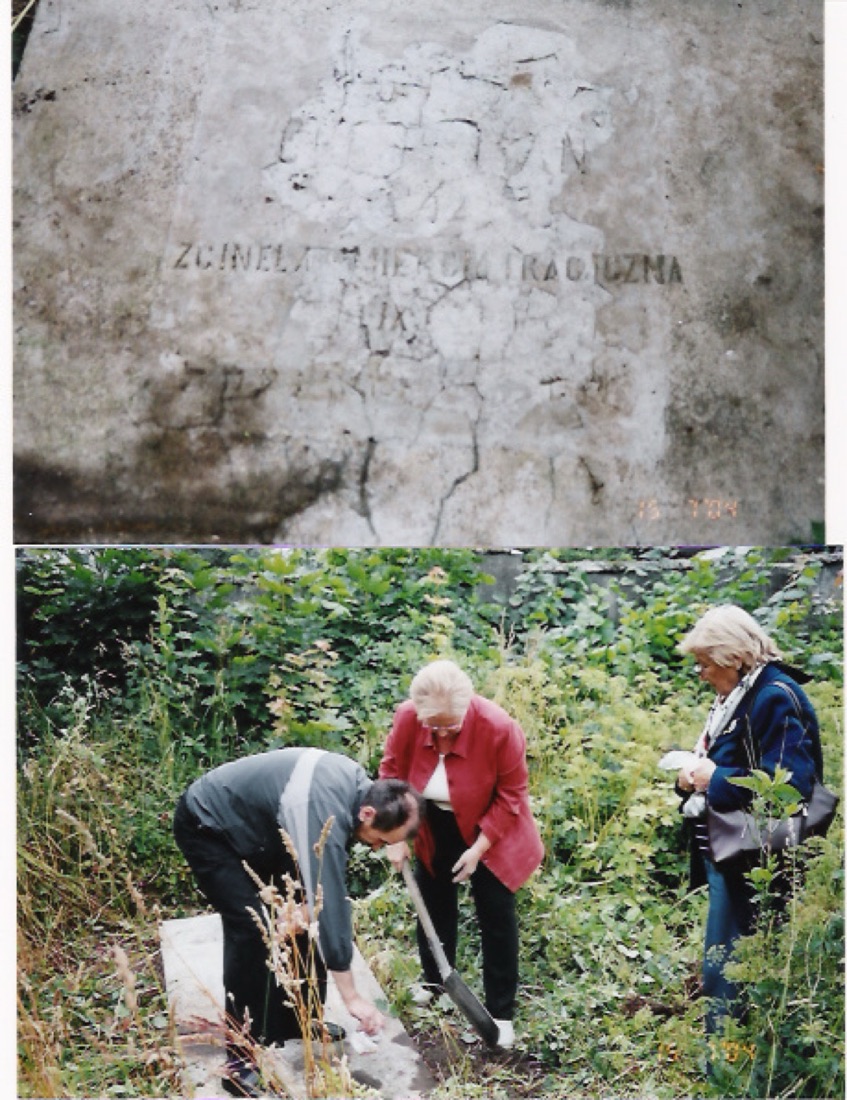
The next stage will be preparing a memorial plaque and inscription like the one we brought from Israel and mailing it to Henyek so that the latter can install it on the grave after it’s restored.
Mom lights again all of yesterday’s memorial candles plus one more on the identified grave of my grandfather and uncle, it clearly appears to be a symbolic act only, there’s no chance a candle will stay lit in weather like this without proper cover.
We leave the cemetery by car for the Traszok house, little Ola gives Mom two drawings she made for her.
Using the bathroom again, before leaving the house we’re given paper bags with gifts, Henryk instructs Ola not to open the door to anyone and locks the door from outside.
We drive to Janina’s apartment, the apartment is located in the neighborhood near Henryk’s neighborhood. The buildings are large, square apartment blocks, a narrow, neglected stairwell leads us to the 2nd floor, the man of the house opens the door warmly, makes room in the small living room, with typical humor he fits the medical aids to his limited limb, the son Jacek shakes my hand and raises an eyebrow, unclear at hearing the name Yishai. He doesn’t know English, and when Mom tells him we’re hurrying to reach Treblinka he notes that the most convenient way to reach Treblinka is by train - a train to Treblinka? Mom and I will talk much more about what this Jacek meant, was it an antisemitic remark? That’s at least Mom’s opinion, and he gets up and leaves the house on errands.
In the small apartment, in a pot in front of a glass window, a tiny lemon tree grows, its owner boasting of its fruit.
A bowl is brought to the living room with chicken thighs and mushrooms baked in the oven, the hosts are curious whether there are mushrooms in Israel. Mom doesn’t touch the food and I finish off one chicken breast - reasonable taste.
Parting, Janina sheds tears, she says “I love receiving people and not parting from people,” and gives us several green paper bags containing gifts. We kiss and go down to the car accompanied by Janina’s husband.
Dolha
We drive to Dolha (the village where Mom hid), Henryk and his wife in the back seat, leaving Mezřich, right after about 6 km, right again onto a narrow road, after about two km the sign “Dolha” points to a road sloping left between houses.
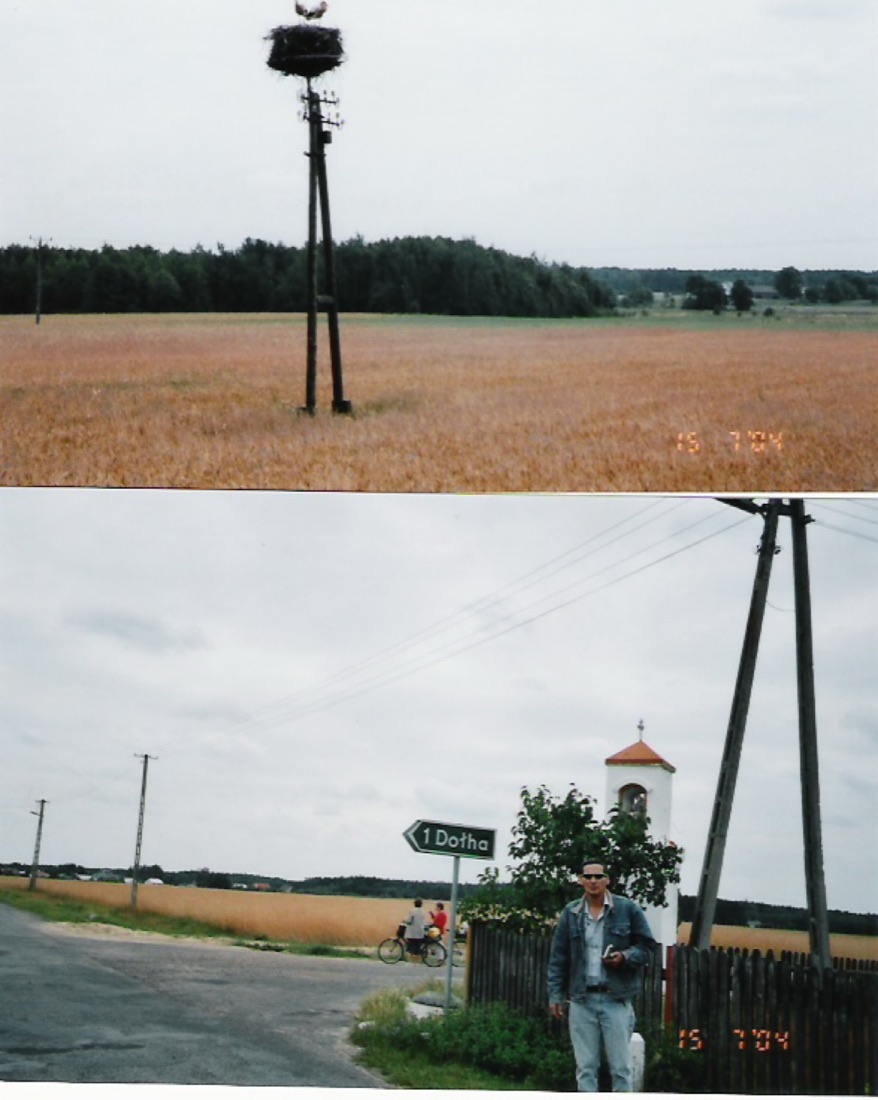
At the edge of the village the paved road ends, builders are setting up in the yard of one of the houses a small shrine to house the crucified figure of Christ, we continue another 500 meters or so, cross a track, and there, on the left, is the Traszok farm, the barn stands with the forest right next to it, this is the barn and forest that came up so many times in my imagination over the years, they were connected by an underground tunnel that Hershel had dug in advance to prepare an escape route, we get out of the car about 50 meters from the yard.
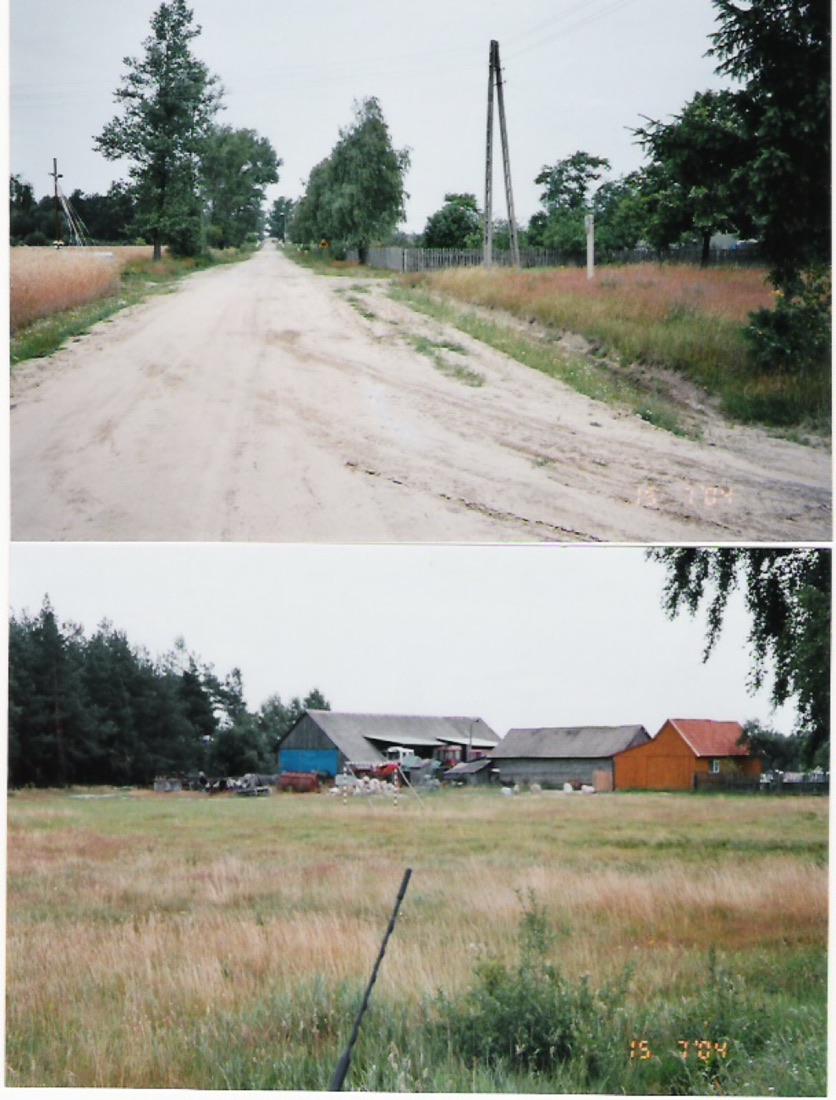
Children play with a ball, farm tools are parked in the middle, a man looks at us with suspicious eyes. The Traszok couple aren’t willing to approach the house because of an ongoing dispute over the heiress who dispossessed them of every right to it, Mom tells how the grandmother, left with only a cow, wasn’t willing to give it to Henryk’s mother so that the latter could give her milk to her little son, only after the matter was brought before a judge for a ruling. I take a continuous, full 360-degree series of photographs. The Traszoks want to take us to the nearby cemetery, right by the village church, where the shared grave of Janek Traszok and his brother Adolek lies.
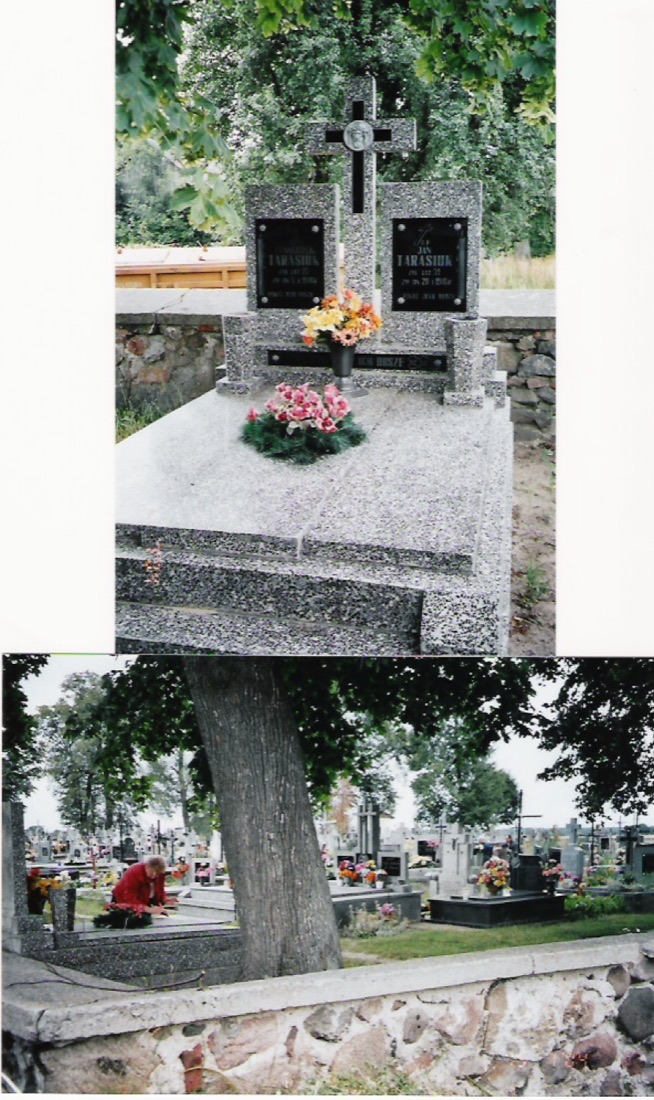
(Janek was murdered in ‘46, when he was only 31, by local Poles after the war, in Mom’s estimation as revenge for having robbed them while armed with a rifle and disguised as a partisan during the war. His brother Adolek was murdered by partisans for handing partisans over to the Gestapo, an older brother is buried nearby, his photo attached, and he’s fondly remembered by Mom, and beside the grave a younger brother named Perczyk, whose grave Mom isn’t willing to look at, is the one who cruelly drove out Yosef’s family when she was a small, sick girl, on a cold night - of course none of what I wrote in parentheses was spoken in the presence of, or with, today’s Traszoks.)
We return to Mezřich, on the way we stop and Mom photographs me by the sign announcing arrival at “Dolha,” parting from the Traszoks at the door of their house I hug the woman and kiss her, apparently I broadcast some distance and she, in an instant and with a determined motion, doesn’t let me pull away - grips, hugs and kisses forcefully.
Treblinka
The road to Treblinka is long, winding and tangled, about 100 km in a general direction north of Mezřich.
We drive on narrow, winding roads, some not marked on the map, passing countless villages, all similar, suddenly, with no advance warning, I show Mom, to the right, a block of concrete with “Treblinka” written on it.
We cross an old railway track, the weeds growing between the ties make clear it hasn’t been used in a good while (remember what Jacek said!).
We park the car in the forest and start walking, apart from one bus arriving with about 30 teenagers, some Polish-speaking and some English-speaking, we see no people. A memorial sign explains that this extermination camp operated for a year, from August ‘42 to September ‘43, and its capacity was the destruction of 800,000 people, of whom over 700,000 were Jews and about 10,000 Poles.
Near the monument I notice a group of about 12 people in white shirts bearing the inscription “Rambam Hospital delegation to Poland” receiving an explanation from a guide in Hebrew, from the group emerges my neighbor from Alon HaGalil, Meirav Sadeh, and together we express the joy and wonder at the coincidence that brought us together there.
The reason we came to this cursed place is Mom’s wish to find the memorial stone of the Mezřich community and light a memorial candle for her mother, my grandmother Elka, who had already been sent, in the first Aktion (if I’m not mistaken it was in September ‘42), on her final journey by train from Mezřich to Treblinka. A few minutes of searching, the sky darkening, and Mom identifies what she was looking for (matching the description of the spot Bracha had mentioned - right there on the right) and she murmurs “oh, my mother, I found Mother,” and I feel Mom is close to fainting, my own emotions also well up within me and we support each other.
Among the stones we find a few small ones and build a tiny wind-shield around the memorial candle Mom lit, and it burns sadly at the foot of the cold stone in memory of our beloved Elka, whom I never had the privilege of meeting.
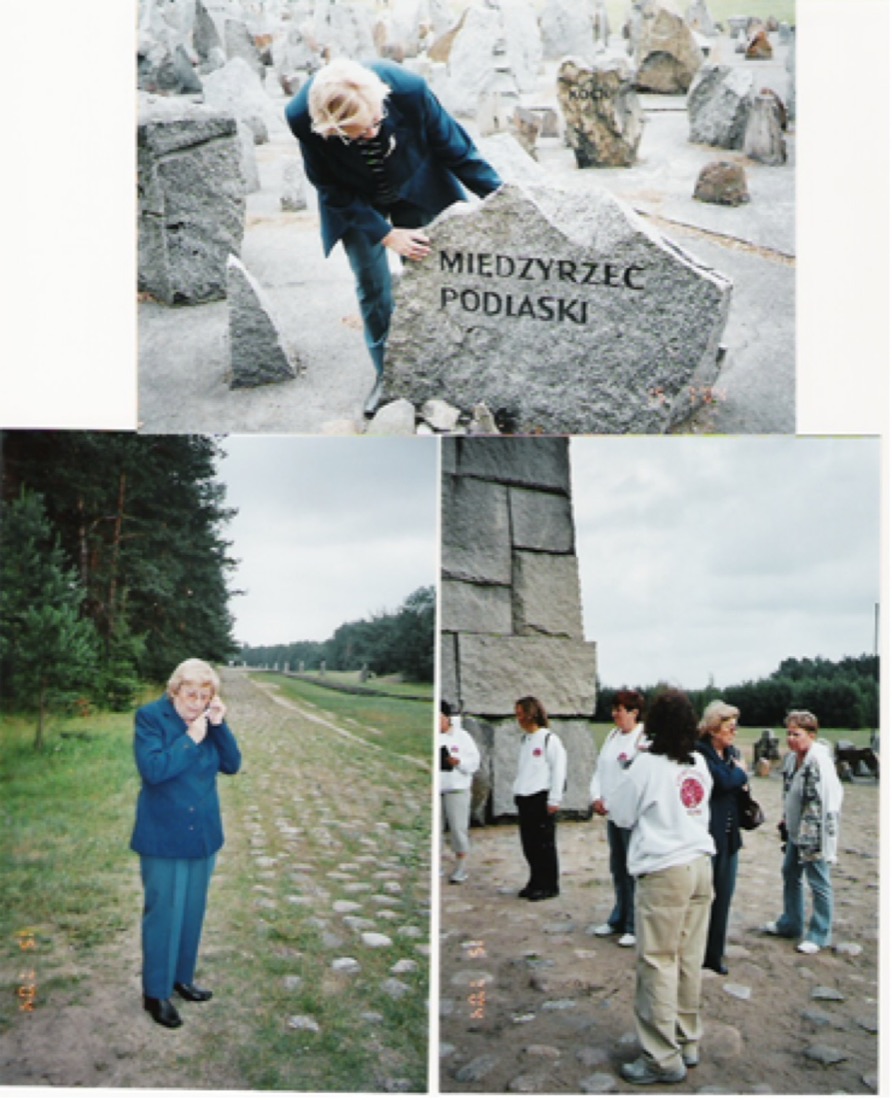
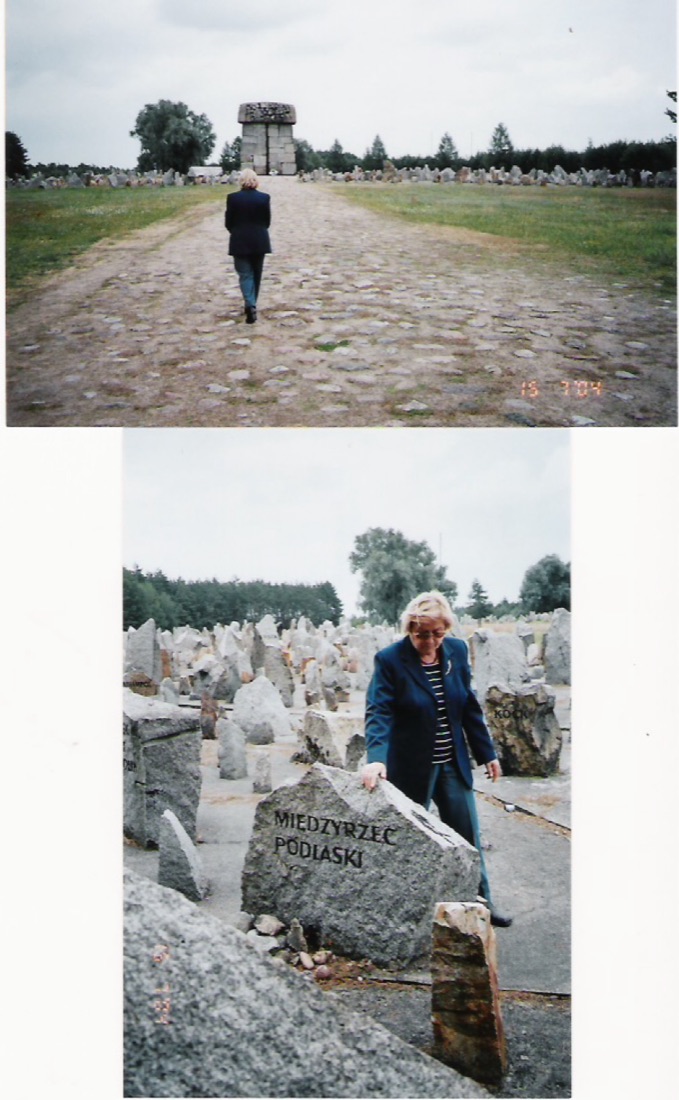
I don’t know if the rationalization I displayed in those moving moments - “in any case, today, more than 60 years on, it’s almost certain she wouldn’t be alive anyway, so what’s really the difficulty? The evil that stole her? The way she was killed?” - helped Mom at all, but for my part, yes.
Meirav comes over to us and suggests we join them for the ceremony, with Meirav comes also the group’s guide, named Ron.
Ron shows interest in where we’re from, and when it turns out we’re from Mezřich, through the Lampert family graves it emerges he knows Zvi, Bracha, Avivit and Anat from when he guided them on a trip to Poland organized by Beit Lohamei HaGeta’ot (Ghetto Fighters’ House). Of course Mom knows him from their stories.
The ceremony is held at the foot of the central monument, evening, the sky overcast and a light rain drizzling, a small group in white shirts bearing the inscription “Rambam Hospital delegation” stands in a half-circle, Mom and I with them. Four people read out loud, each in turn.
Heavy, thought-provoking and especially impressive was the content and the manner of reading of a long letter in which the writer recounts her life as a daughter and as a mother in a home of Holocaust-survivor parents, the letter begins with her grandmother Elka. (I recorded the entire ceremony on an audio cassette.) It was hard for everyone, we part with bowed heads and tearful eyes and walk slowly along the path between the trees, suddenly a phone call from Dad brings us back at once to a reality thousands of times better than the one that prevailed on this cursed ground 62 years ago.
We drive in the general direction of Warsaw along an old railway track that hasn’t seen a train in years, cross the great Bug river on a wooden bridge. Going up onto the wooden bridge is via a very narrow concrete passage (apparently so as not to allow heavy vehicles to cross).
In one of the villages we spot a new, well-kept house with a sign reading HOTEL, a Polish woman in her 40s accompanied by a barking dog opens the door, we go up after her to the second level, where there are about 4 rooms, hesitating, “we’ll be back in about an hour,” Mom says, and we continue driving. We check a few more hotels along the way that don’t look suitable.
Mom very much wants hot soup, so we stop at one of the hotels that has shared bathrooms, of course we don’t stay there but dine well at its restaurant.
A few more kilometers and we’re about 30 km from Warsaw, we pull in for our first refueling, right next to the gas station stands a roadside hotel. I warn Mom not to even try, since it surely won’t be to her liking, nevertheless Mom checks, and wonder of wonders, the hotel is clean, new, well-kept and pleasant, and we stay there for the night.
Even before turning in Mom spends about an hour writing in her notebook. The previous night there was no writing desk in the room, and here there is one, to Mom’s delight. The pleasure of reading a book in bed - Mom, who forgot her books at home, enjoyed Teddy Kollek’s book “One Jerusalem,” which I’d brought for myself, and I read “Hitler’s Shadow,” the book by investigative journalist Yaron Svorai describing a neo-Nazi organization he infiltrated disguised as a sympathizing researcher.
Mali gives us the phone number of the El Al office in Warsaw so we can try to move our flight up to that evening (together with the flight of the Rambam group), the attempt doesn’t succeed, and we deliberate what to do with the three remaining days until our return flight - maybe drive to Gdańsk in the north, about 500 km away, or south to the salt mines I know from “Wieliczka,” and continue to “Zakopane,” also about 500 km away, a picturesque resort town in the Tatra Mountains on the Slovak border.
Breakfast at the adjoining restaurant, we decided to continue south. We pass through the center of Warsaw, the Vistula River makes no particular impression. Mom tries to navigate within Warsaw to find our way south, without much success, finally we’re on the road toward Kraków passing through “Sandomierz.”
Along the narrow road one can make out dozens of vendors trying to sell various kinds of forest fruit, we stop by one of them, meaning to stock up on cherries. 4 zloty per kilo, we have only 3 coins, the vendor refuses to give less than a kilo and generously fills for us a huge bag, at least 1.5 kg, for the three zloty.
Several hours of intensive driving, for no small part of it we join in singing along to the songs playing on the CD player installed in the car, songs of the Ma’apilim Trio, mainly the song “You Planted Melodies in Me, Mother and Father” (all this from a disc I remembered to squeeze into my packed bag, I also took a cassette of the songs of the singer Zohar Argov, and since Mom isn’t fond of his songs I mostly played it for myself during our stays at the hotels).
Two stops, both at restaurants attached to gas stations. The first for the restroom only, the second for the restroom and coffee. A young, bespectacled Polish woman with an eagle-like nose, impressive in her height and in her plainness, dashes about the restaurant around a girl suffering from excess energy.
We reached Kraków around 16:00, at a McDonald’s restaurant we ate the usual food, fries (frytki) and chicken (kurczak).
The continuation of the road toward Wieliczka was a bit problematic since sections of the new E7 highway didn’t appear on the map, but here too intuition brought us almost without error to our destination. A chronic problem that exists on Poland’s new roads is the formation of deep ruts due to heavy trucks, when you drive a private car into a rut, something very hard to avoid, the car is already carried along in that direction on its own.
19:30, the last descent to the mine. We went down, Mom in uncomfortable heeled shoes made her way through the long, winding tunnels following the Polish guide at a pace that would not have shamed a Shayetet commando.
Every word about the unbelievable beauty revealed in the depths of the earth would be superfluous - halls, sculptures, a water pool, chandeliers and churches produce one long feeling of awe.
The elevator ride up at the end of the tour, which for me was the traumatic experience of Poland from my previous visit, didn’t make as strong an impression on Mom, perhaps because of the preparation she’d had for it from my descriptions.
When we came out heavy rain was falling, the time was around 21:30, we found a very nice motel near the mine, its main advantage being that the room was equipped with a hairdryer - something Mom had so sorely missed the previous two days.
Dinner at the hotel restaurant, Friday evening - we talk and imagine the lighting of Shabbat candles, Mom asks for toast, a bit of a problem but in the end it’s brought to us.
With an unarmed but suspicious eye I examine the traces of pale reddish slices hidden deep in the cheese, a warning cry to Mom not to taste their forbidden flavor.
Mom, in the most practical way, pushes them aside and bites into the parts she separated from them. I wasn’t able to, so I stayed hungry.
The road to Zakopane
In the morning we continue south, a stretch of about 110 km along the E7, the landscape changed drastically from sandy plains to mountainous terrain with rivers and streams, the largest of the rivers is supposed to be called the “Dunajec.”
A refueling stop at one of the spectacular peaks along the way is used to call my friend in Israel, Meir Moaz, to get the phone number of his brother and his family (Moshe and Ruti Mor) who had recently moved to live in “Zakopane.”
We also tried calling Latam, staying in Japan, to wish her a happy birthday, she’s turning 23 today, but the attempt didn’t succeed.
We reached “Zakopane” while crawling our way through an endless traffic jam for about an hour, today is a spring-like day, temperature around 24 degrees (later we were told that three days earlier it had snowed here), a town bustling with tourists, a call to the Mor family and within a few minutes we’re at their home.
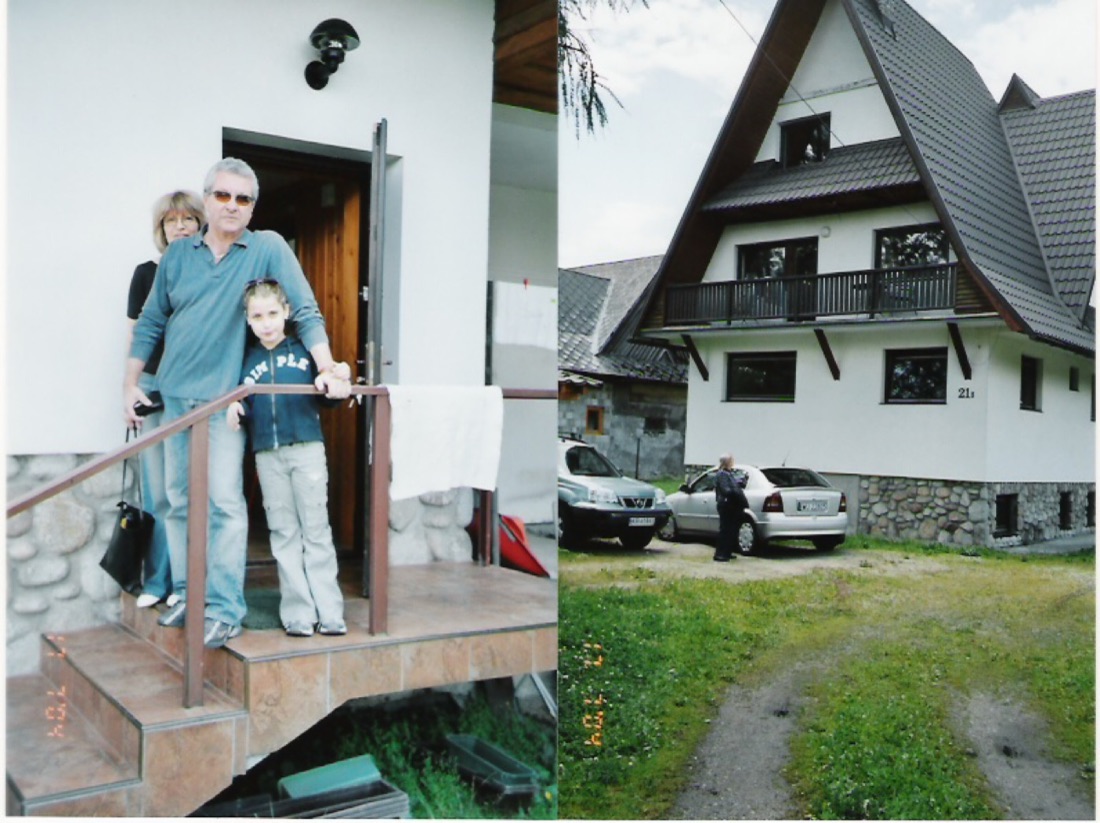
The last time I saw them was in ‘78, during the officers’ course, I came with Meir to their apartment on Tchernichovsky Street in French Carmel, for some reason I called the little blonde, charming girl who came out to greet us from the house by the name Vered, but her name is Noy. Vered is Mom’s name, whom I’d only seen in ‘78 - amazing.
Ruti welcomes us into her kitchen, which she hadn’t yet finished arranging.
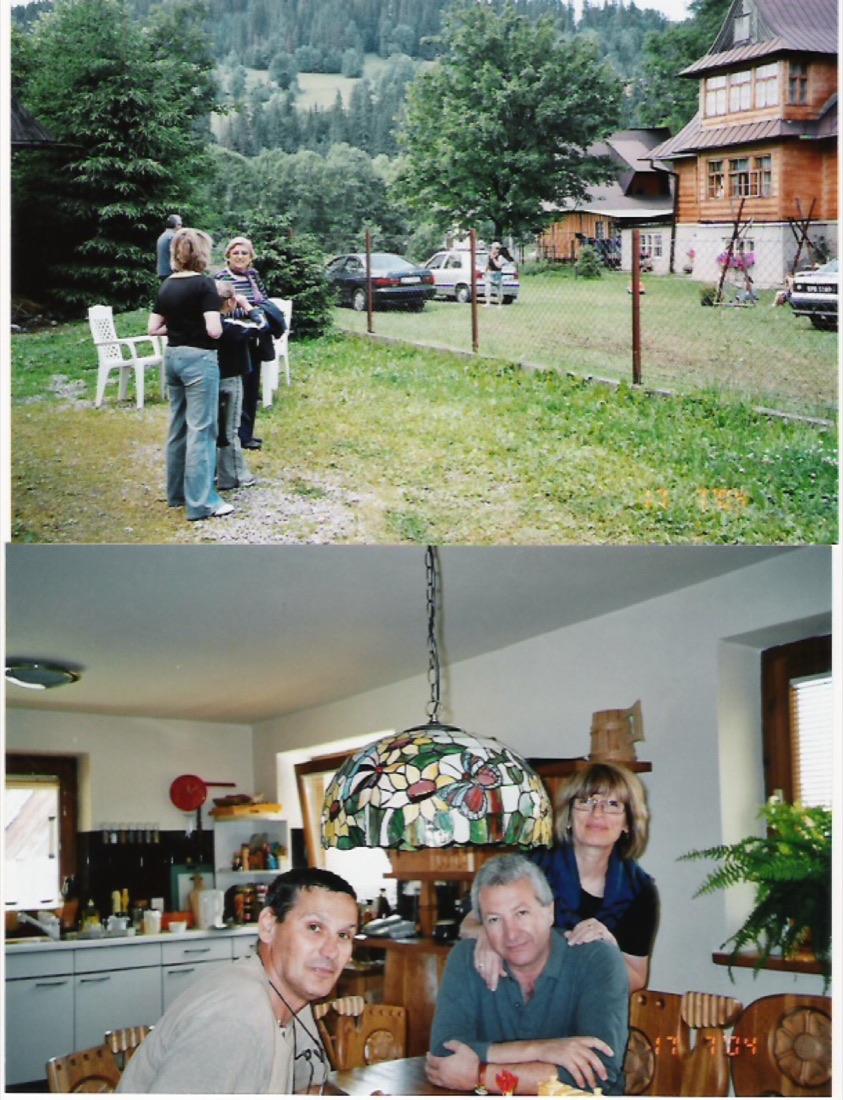
Moshe gives us a tour of the large apartment. The apartment is in various stages of renovation, one part meant to serve as their living quarters while the other part is intended to be a guest apartment for tourists, like all the other houses in the “Zakopane” area.
The conversation between Mom and Ruti very quickly reaches the point where Ruti finds herself justifying the move to live in Poland - unnecessary, it’s good for them, it suits them, it doesn’t hurt anyone, so why not? Ruti keeps slipping in remarks that are mainly admiring of Mom. Indeed, true, Ruti has a good eye.
Together we stroll through the town bustling with life, picturesque restaurants, bustling markets, young people singing, the first market is a market of all sorts of antique knick-knacks.
Mom buys glass miniatures, Moshe takes an interest in antique clocks, and I look at a picture of Hitler and pictures of bearded Jews being offered for sale.
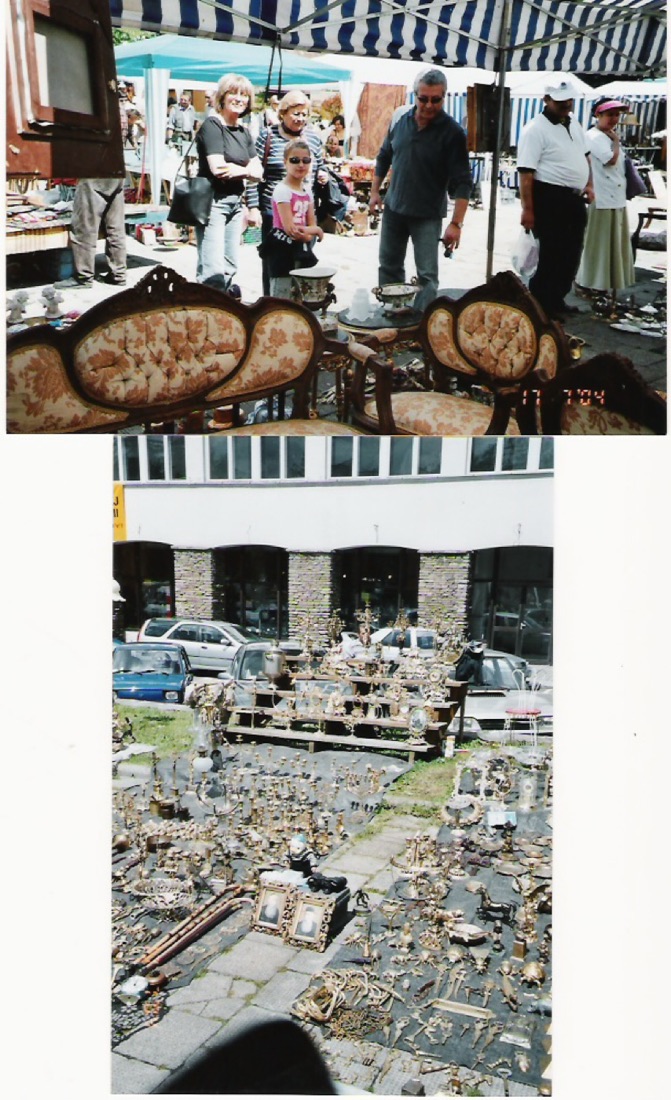
On the promenade beside us are crowds of people, of every kind but mainly young, also mountain men - “Gorals” - in typical dress display themselves, smoked cheeses are offered for sale and we buy some, also cute Saint Bernard puppies are offered, which we only look at, the quiet is the most striking thing for me in this crowded pedestrian street.
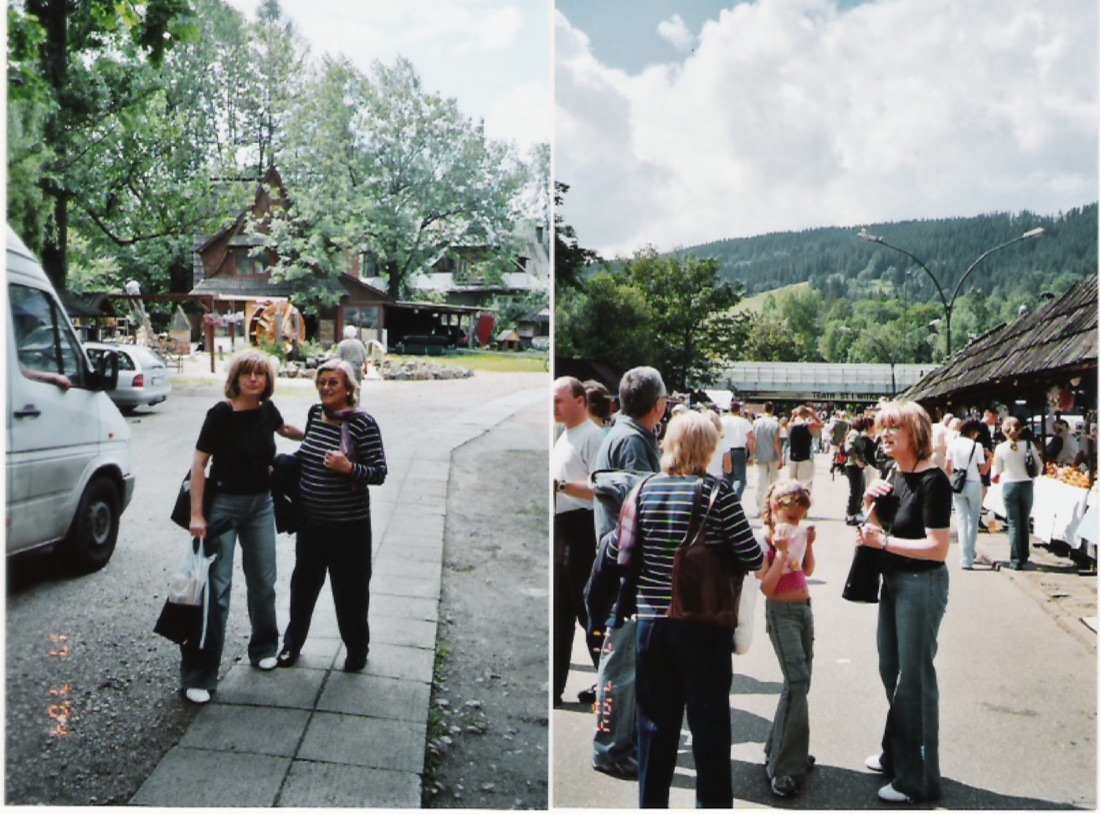
All this time Moshe and Ruti emphasize to us the advantages and beauty of the place.
We pass in front of an impressive church - this is the church where a hundred children were housed on their way to Israel after the war, according to what’s written in the book “My Hundred Children.”
We go up on the cable car for a view of the town and its surroundings, since today is a sunny day many people go up alongside the cable car exposing their bodies to the warm sun rays. At the mountaintop we dine together inside a structure made of massive wood.
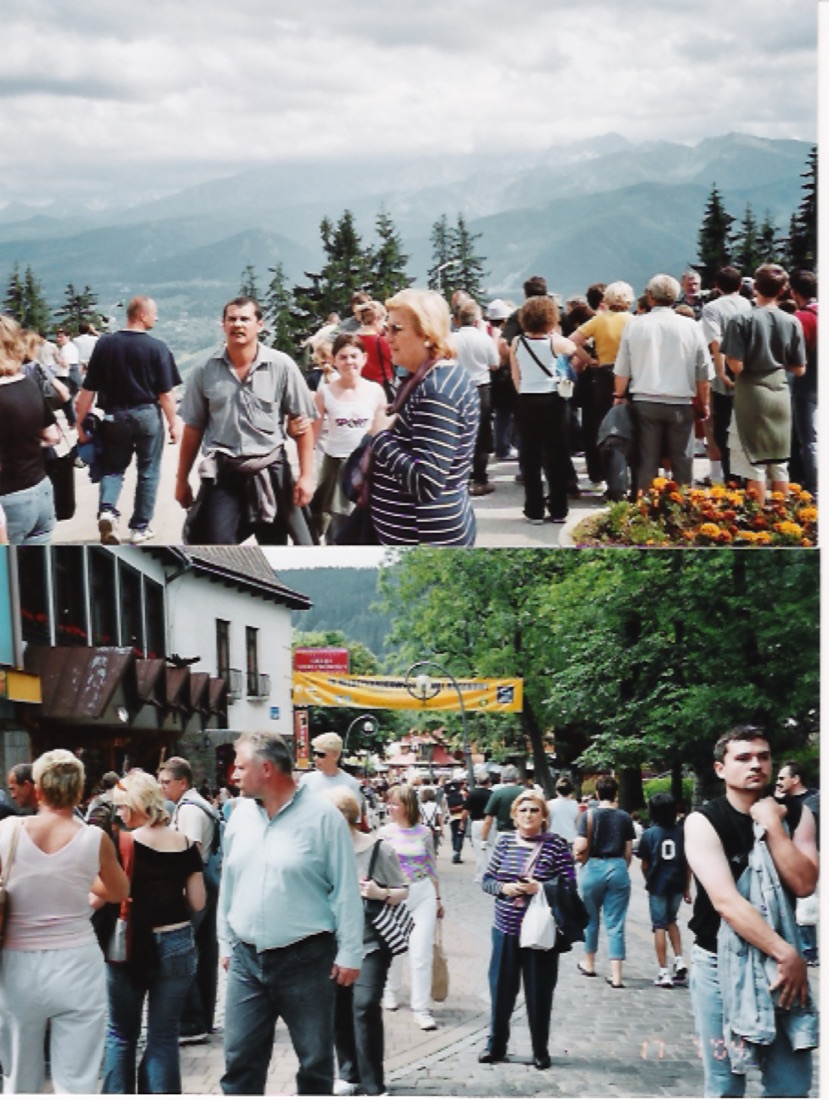
On the way back Moshe decides to return to the “knick-knacks” market (Moshe collects old wall clocks at home), Noy and I wait for him in his Nissan 4x4 while Mom and Ruti go into a pastry shop. Moshe comes back with a new, handsome clock, we all admire the clock but it clearly seems Moshe more than any of us, Ruti protests something at him that sounds like “there go my new jeans,” and clever Noy says “Grandpa, now you’re happy you have the clock,” and Moshe replies, “I’m happy because I have you, Noy” - touching.
The road back to Warsaw
Around 17:00 we part from our hosts and set out driving back north, our intention is to reach halfway to Warsaw, to the village area I know from the year before by the name “Olszany,” in order to stay the night and meet the special and interesting Mrs. Berzhina, fondly remembered.
We pass Kraków again to “Jędrzejów,” we arrived in the dark, left for a further drive of about 80 km on narrow, dark roads toward “Little Olszany” near the district town of “Częstochowa.”
During the day we tried several times by phone to make sure we could stay at “Little Olszany” but the person on the other end of the line wasn’t able to give a clear answer.
We reached the lodging but found it closed, not a living soul, a dark yard and dogs barking. Rather disappointed we made our way to the main road toward “Częstochowa” to find another place to stay.
And indeed within a few minutes we found ourselves resting in a spacious room with walls painted sky blue.
In the morning we continue driving to Warsaw, we passed at least 5 roadside restaurants before finding one that satisfied us, where we were served an egg in an individual pan for each of us, a chopped tomato with a bit of onion.
We entered Warsaw around 12:00, not before making one last use of the clean restrooms of a McDonald’s restaurant.
Home
We handed the car back to the rental company, deposited our belongings at the storage counter for 42 zloty, and hop, into a taxi for a tour of old Warsaw with a driver who never stopped explaining things and chatting with Mom.
From the driver we understood this was now a last chance to visit the Presidential Palace, we got out of the taxi and stood in line, within about an hour we were inside the palace guided by a knowledgeable Pole among the halls and magnificent furnishings.
We came out of the palace to an Italian restaurant where we ate good pizza for the first time, the waiter who served us looked like a doctor of nuclear physics, and beyond that he also spoke fluent English, the generous “tip” he received produced no expression of gratitude on his face whatsoever (like every other Pole we met).
In the old part of the city we strolled together with the crowds of other tourists, mainly we were charmed by the playing of a young accordionist, and the playing of a boy of about 13 on trumpet who played a tune from the musical “Fiddler on the Roof,” Mom rewarded him with a generous tip.
Toward 16:00 we went into a huge church for an hour-long organ concert. Dim and cool, people dozing off, the organist in the back and the people looking forward. Facing us the crucifix in a fenced-off alcove, and every person who arrives kneels and crosses themselves.
We went out to the street, went into two painting galleries in the area and then to a restaurant once more, this time for the last time, and we head back to the airport.
The area from which the El Al flight departs is secured in a way I’d never had the chance to see before - burly fighters wearing folded stocking caps, with loaded Uzis in their hands, look in every direction, scour every corner, even in the women’s restrooms. We were given an especially thorough search since we were carrying gifts from people we don’t know, and our belongings had also been out of our hands for several hours.
The return flight departs on time (Captain Ofer Ziv), the sweet and relaxed flight attendants serve rich and especially tasty food. We land 10 minutes earlier than expected, 01:40.
Mali and Dad receive us, the drive back on Route 6 reaches Umm al-Fahm on the last drop of fuel. At the house in Alon HaGalil we get ready for bed, Mom and Dad in Adi’s room (Adi is currently going through the selection process for the Shayetet).
At 05:00 we’re all asleep.
Yishai Wexler.
Ramat Chen Neighborhood
August 2026
“Like the immigrants from other countries and cities, the emigrants from Mezritch* were housed on their arrival in the Land of Israel in tents, huts, shacks, and in the ruined dwellings of Arabs in Jaffa, Lod, Ramla, and elsewhere.” (Sefer Mezritch*, 1978, page 367).
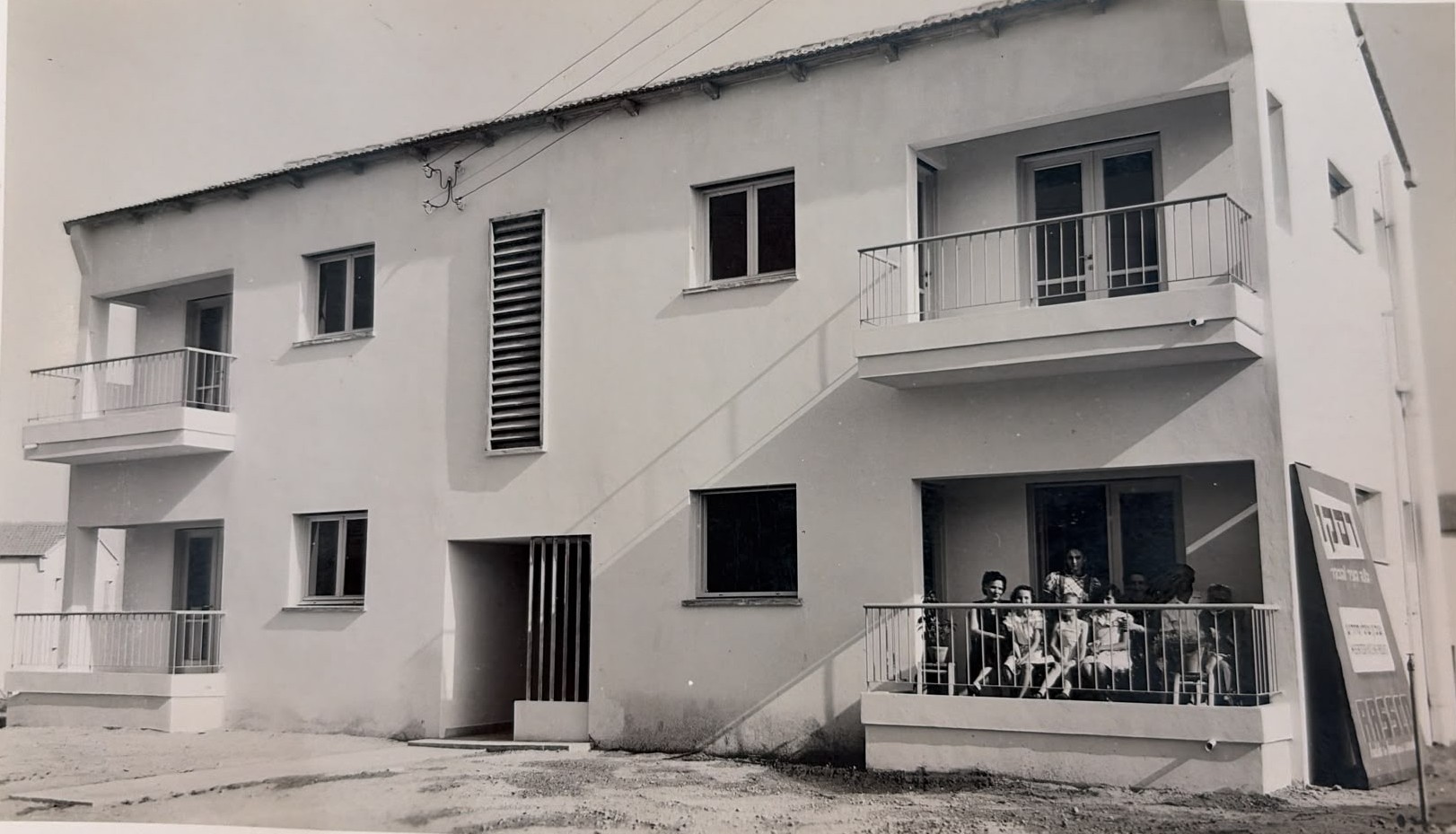
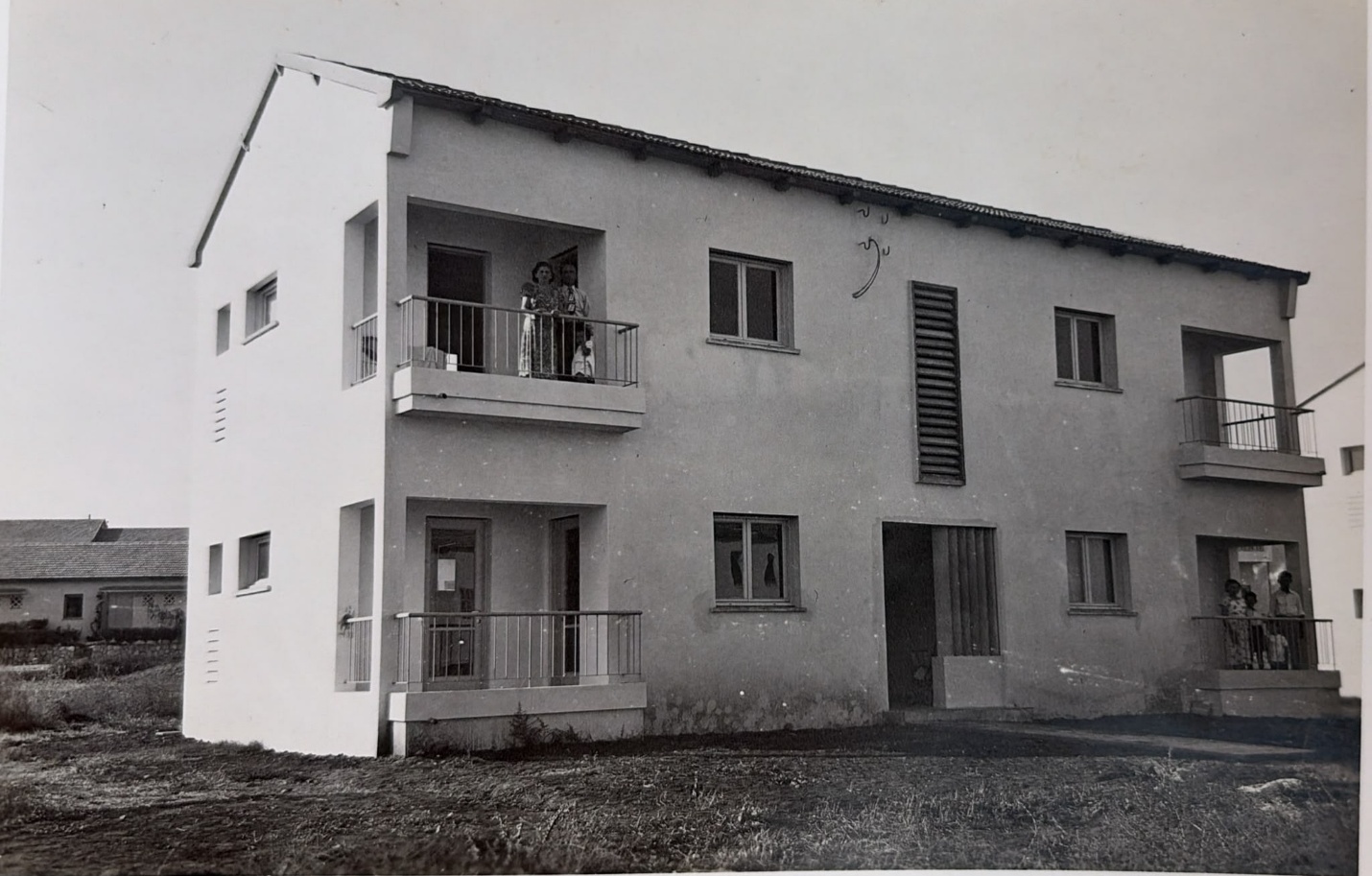
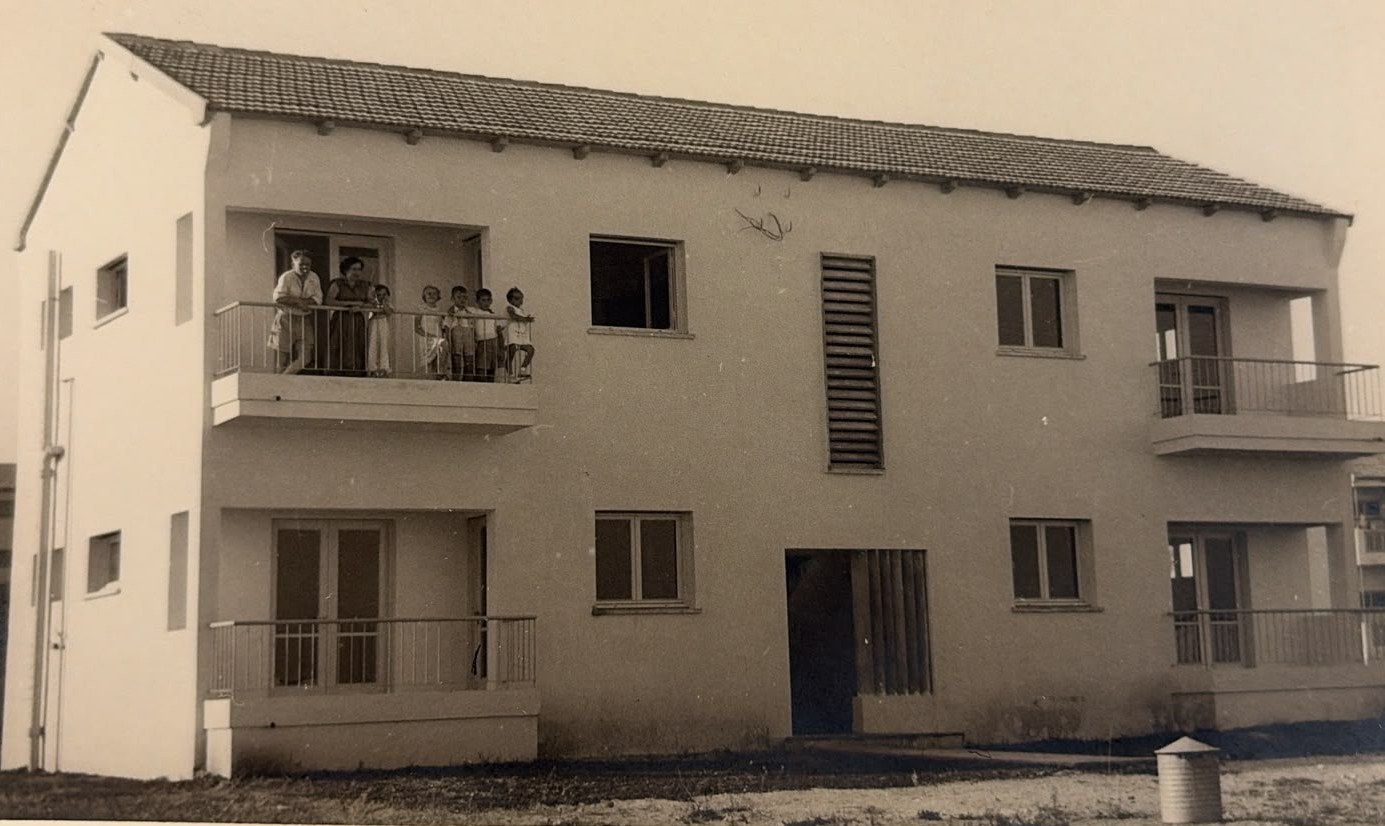
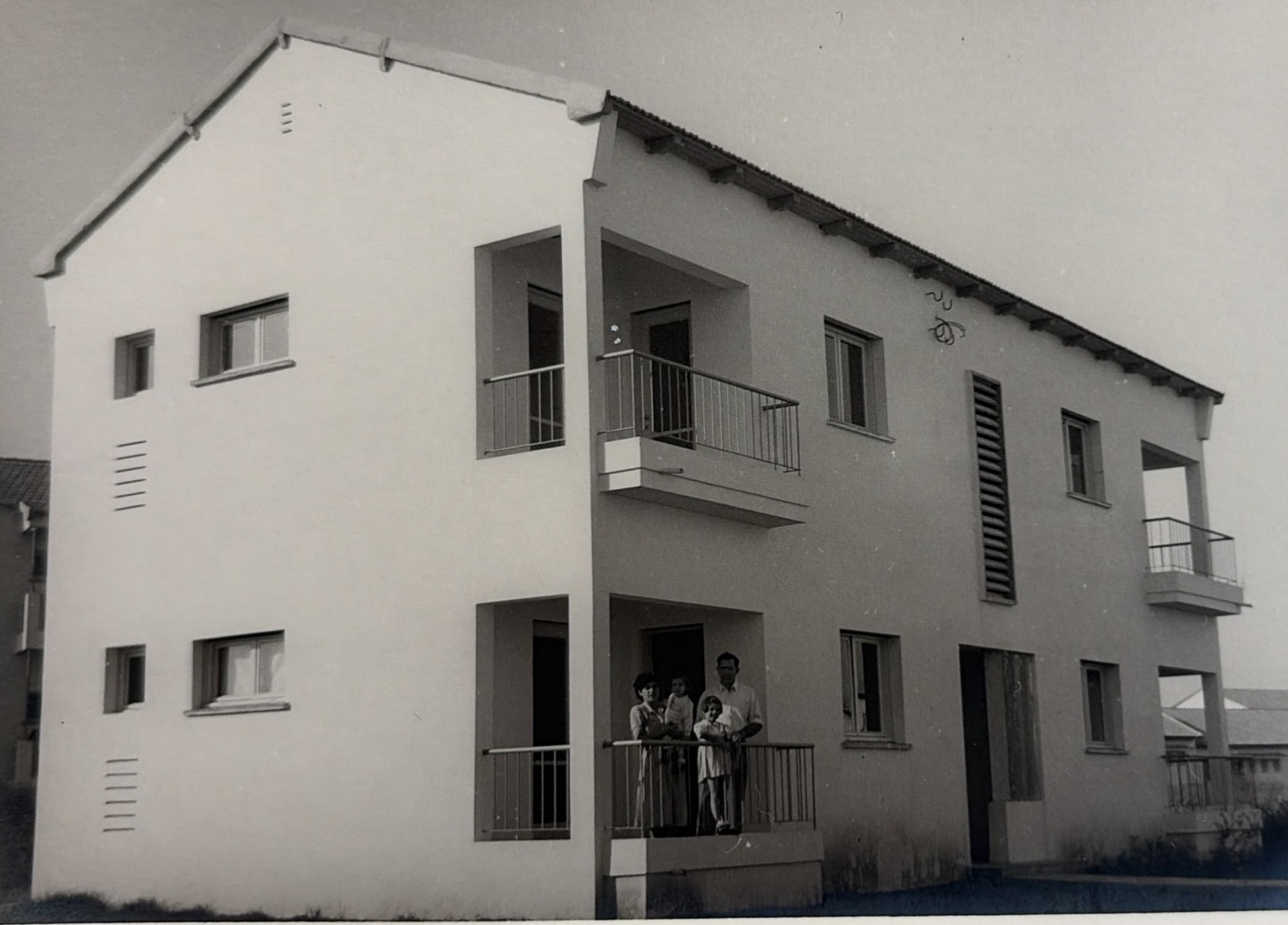
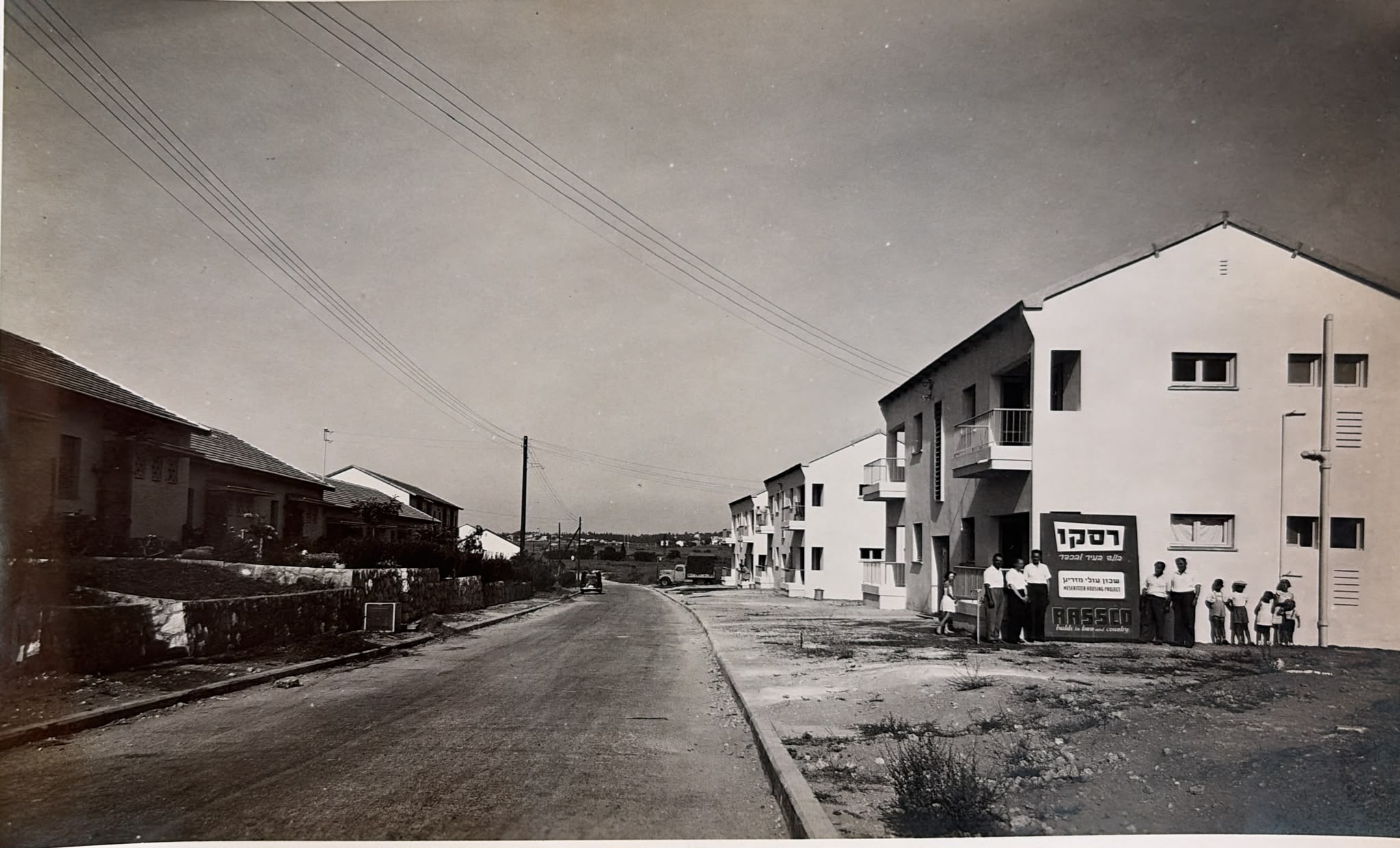
The committee in Israel recognized the need to establish housing for the emigrants of Mezritch,* and with the help of the Mezritch emigrant organizations in the United States, Argentina, and other countries, the plan began to take shape in the early 1950s. In March 1955 the contract was signed with the Rasco company to build 6 buildings with 24 apartments in the Ramat Chen neighborhood. Demand for the apartments was high — more than 70 families registered. The 24 registered Mezritch families who won the lottery began moving into the modest apartments in mid-1956.
It soon became clear that this was not merely a housing estate or a residential neighborhood of a few families. It was a neighborhood of friends and relatives, some of them childhood friends or family members (uncles, cousins, and the like). In every family, at least one of the adults was a native of the town of Mezritch Podlaski.
Moreover, the move from their previous homes to Ramat Chen was a significant improvement in many respects: safety, education, youth activities including a playground, a nearby clinic (health fund), regular public transportation to Tel Aviv and Ramat Gan, performances at the nearby national park, and more.
In short, life in the estate, in the new Mezritch community, was good.
Because the families knew one another, the ties were close. Celebrations, bar mitzvahs, weddings, and the like were, in most cases, communal events. A visit by a fellow Mezritcher from Israel or abroad was also a communal occasion, as the guest would visit several families in the estate.
Words alone cannot describe the importance of living in the Mezritch estate. The families who lived there rebuilt their lives quickly in the new country and supported one another. The adults managed to renew ties with childhood friends. The younger generation — the next generation — was given the opportunity to learn about the town, which no longer exists, and to continue the tradition of eternal remembrance.
As in any other neighborhood, neighbors passed away, neighbors emigrated to America or Australia, the younger generation built their homes elsewhere, and so on.
The estate, as the Mezritch estate, ceased to exist in the 1980s–1990s. But the memories are still strong!
* The town of Mezritch–Podlaski (in Hebrew) is written in various sources as Mezeritsh or Mezritsh.
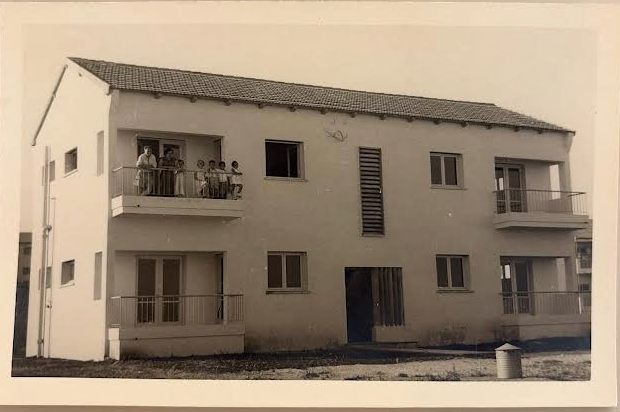
The estate had six similar buildings. Each building had four apartments — three buildings on Bnei HaNevi’im Street and three on Shalom Aleichem Street.
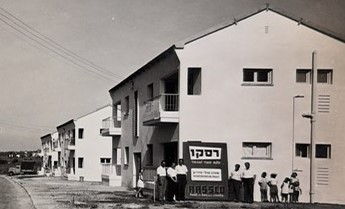
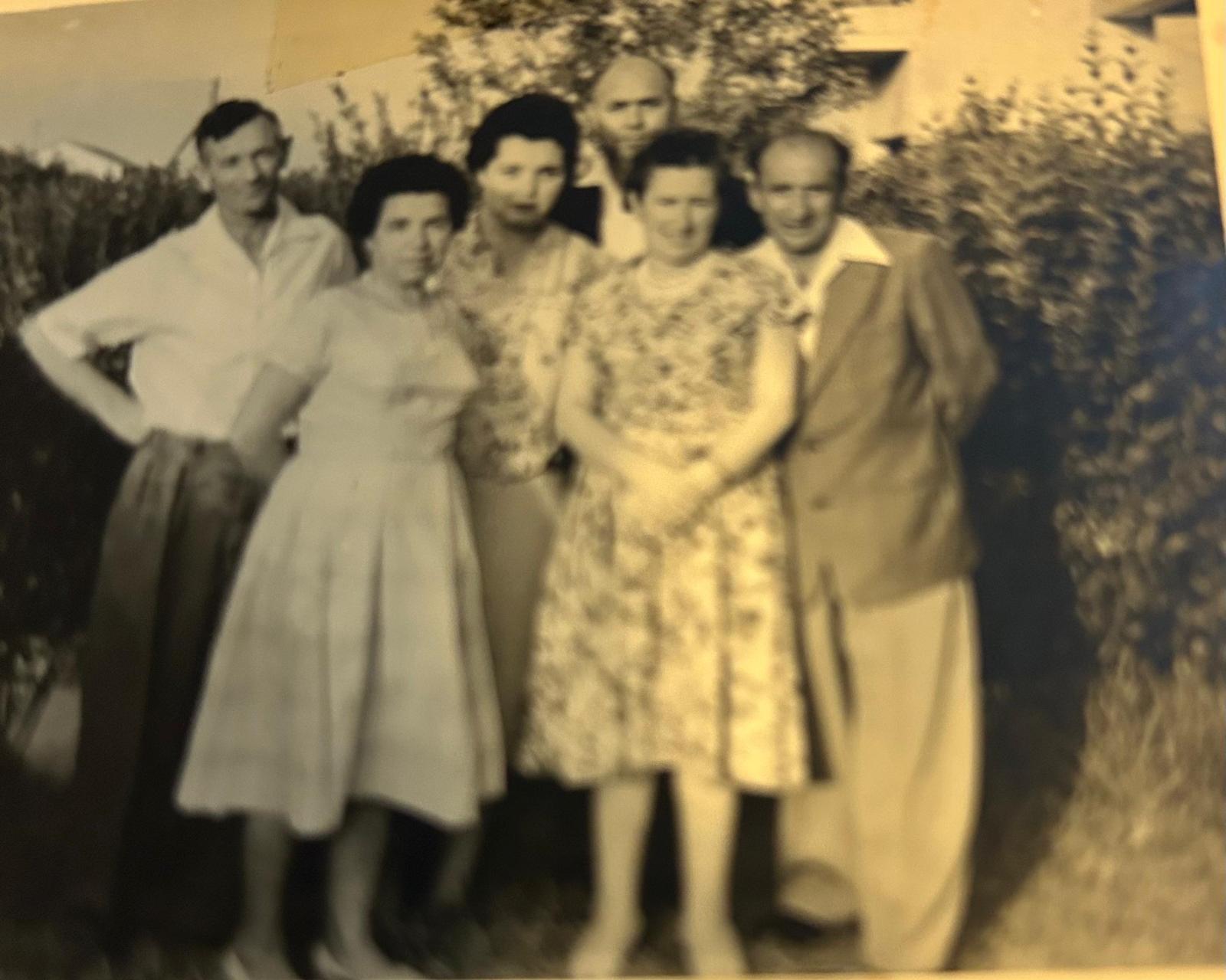
Impressions from Visits to the Mezritch Estate
Like One Family
Every time we came to the Mezritch estate to visit the Wishkovsky family, our cousins, we felt that we had arrived home. Even before we climbed the stairs, we could already hear the voices of neighbors greeting one another, and the aroma of cooking rose from every apartment.
The door was almost never locked. Neighbors would come in to say hello, to ask how things were, or to bring a plate of cake fresh from the oven. When people sat down to eat, it was clear there was always room for one more chair and one more plate. No one needed a special invitation.
The children played together in the yard until nightfall, and the adults sat on the benches, talking, laughing, and caring about one another’s well-being. If someone needed help, there was always a neighbor who lent a hand.
The buildings may have been simple, but it was the people who made the Mezritch estate a special place. It was a neighborhood where everyone knew everyone, and the neighbors were much more than neighbors — they were one big family.
(Tzipi Weinberg-Novik, 2026)
Memories of the Neighborhood
My name is Ilana Hecht, daughter of Yaakov and Liebele/Adelman Sternfeld, of blessed memory. My parents, my brother Yehuda (of blessed memory), and I lived in Rishon LeZion. In the Mezritch estate lived my aunt and uncle, Leah (my mother’s sister) and Moshe Boimpluk, and their son Zvi. My family and I visited the Mezritch estate very often; we would come by bus during every school vacation and on every Shabbat and holiday. We made friends with the neighborhood children and played together in the yards of the houses. The homes were small, the atmosphere was familial and welcoming, warm homes full of humor and laughter and, of course, many stories about the town that we came to know by heart. I remember that in the 1960s–70s, some of the residents began to leave for the United States, and my aunt and uncle left for the U.S. along with them. In my youth I traveled to visit them in Brooklyn, and there I met a large number of the Mezritch residents who had left with their children and remained together, close to one another. In summary, today, from the vantage of my age, I still have wonderful memories and a longing for the Mezritch neighborhood/estate.
(Ilana Hecht, 2025)
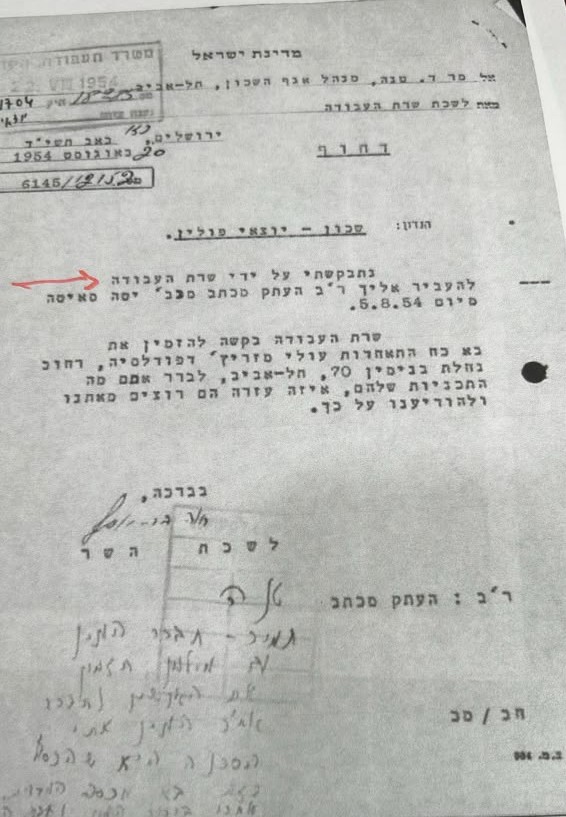
A Letter from Minister of Labor Golda Meir Regarding the Housing
Photographs of the Estate from the Collection of the Late Gad Finkelstein